Temperature Converter

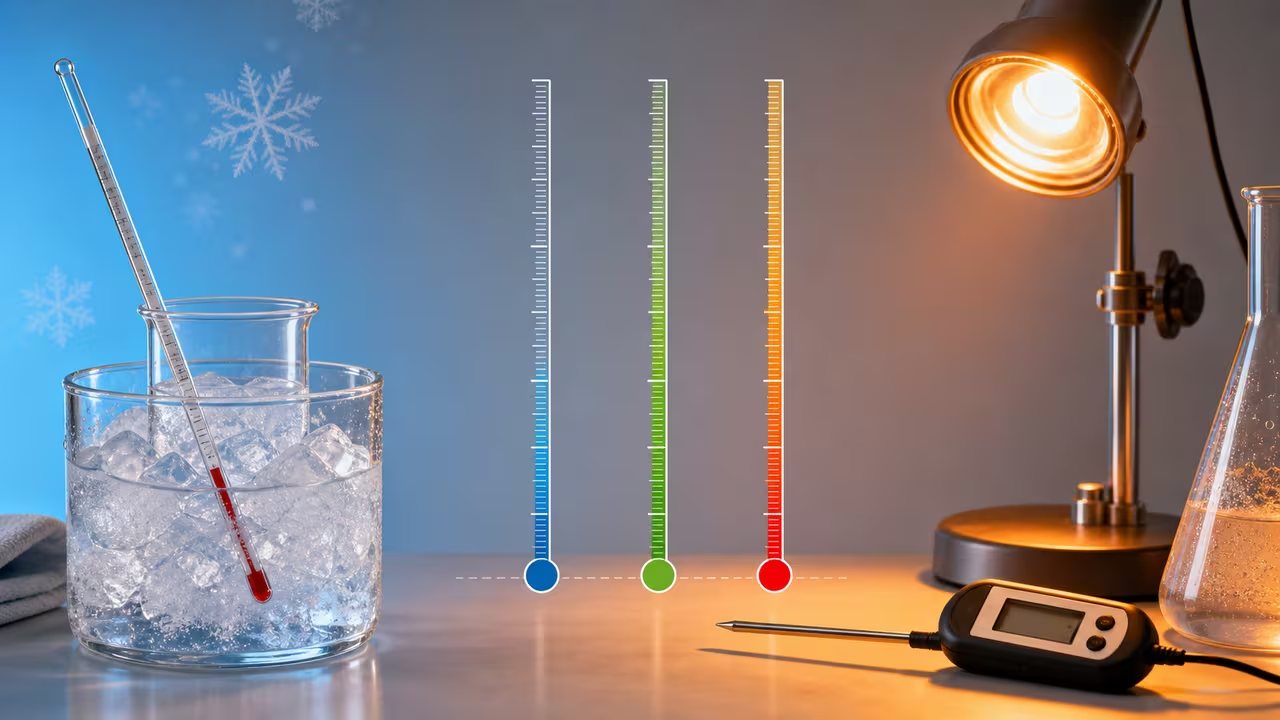
Understanding Celsius, Fahrenheit, and Kelvin Temperature Measurements
Temperature conversion translates one physical thermal condition into the number used by another scale. Celsius, Fahrenheit, and Kelvin use different zero points and degree sizes, so a weather report, oven dial, or laboratory reading can look very different even when it describes the same temperature. This converter turns a value entered in any one of those scales into all three equivalents, helping with recipes, travel forecasts, equipment documentation, and science coursework.
The Celsius scale, written as °C, uses convenient water reference points at standard atmospheric pressure: water freezes at 0 °C and boils at 100 °C. Celsius and Kelvin have equally sized intervals, so moving from Celsius to Kelvin only changes the zero point. In MathML, that relationship is . A change of 1 °C is therefore also a change of 1 K, although the displayed values differ by 273.15.
The Fahrenheit scale, written as °F, is widely used in the United States for weather, cooking, and many household controls. Water’s familiar reference points are 32 °F for freezing and 212 °F for boiling at standard atmospheric pressure, a span of 180 Fahrenheit degrees. To convert a Fahrenheit input in this temperature converter to Celsius, use . The reverse conversion is .
Kelvin, shown as K without a degree symbol, is the absolute temperature scale used in physics, chemistry, and engineering. Its zero is absolute zero, so Kelvin readings cannot be negative. Converting Kelvin in this calculator is a direct offset: . That absolute starting point is why Kelvin is used when an equation requires an absolute temperature rather than a relative Celsius or Fahrenheit reading.
Introduction: Why Celsius, Fahrenheit, and Kelvin Conversion Matters
Temperature conversion matters whenever the source and destination use different scales. A recipe may give an oven setting in Celsius while the appliance is marked in Fahrenheit; a traveler may need to interpret a forecast reported in an unfamiliar scale; and a laboratory result in Kelvin may need a Celsius equivalent for everyday context. Entering the original reading and its unit avoids mistaking a numerical value for a temperature on the wrong scale.
Many temperature-sensitive tasks also depend on preserving the original measurement context. Refrigeration limits, heat-process instructions, and sensor specifications may use one scale while a nearby display uses another. This converter supplies equivalent values, but it does not replace the conditions or tolerances specified by the relevant manual, experiment, or recipe.
Celsius, Fahrenheit, and Kelvin Conversion Table
This temperature conversion table lists several familiar reference points in Celsius, Fahrenheit, and Kelvin. It shows why equal physical conditions do not have equal numerical readings across the three scales.
| Celsius (°C) | Fahrenheit (°F) | Kelvin (K) |
|---|---|---|
| 0 | 32 | 273.15 |
| 100 | 212 | 373.15 |
| -40 | -40 | 233.15 |
| 37 | 98.6 | 310.15 |
Historical Context of Celsius, Fahrenheit, and Kelvin Scales
The temperature scales in this converter emerged from different scientific and practical traditions. Fahrenheit developed reliable liquid-in-glass thermometers in the early eighteenth century. Anders Celsius later proposed a centigrade scale that became the modern Celsius convention, and William Thomson, Lord Kelvin, introduced an absolute scale suited to thermodynamics. Their continued coexistence explains why conversion remains useful rather than merely historical.
Today, Kelvin is standard in many scientific calculations, Celsius is common for weather and education in much of the world, and Fahrenheit remains established in U.S. daily life. Familiarity affects how people judge a reading: someone accustomed to one scale may recognize a comfortable or dangerous range immediately, while the equivalent number in another scale needs translation. A converter provides that translation without changing the underlying temperature.
Practical Temperature Conversion Examples
A temperature converter is useful for concrete tasks such as adapting recipes and reading laboratory notes. For an oven instruction of 200 °C, the Fahrenheit relationship gives , so the matching Fahrenheit setting is 392 °F. For a laboratory reading of 295 K, the Celsius conversion is , placing it near a typical indoor temperature.
Forecasts provide another straightforward temperature conversion use case. An overnight low of 10 °F converts to Celsius as . Seeing both readings can make it easier to compare forecasts, choose clothing, or interpret weather advice expressed in a different scale.
Formula: Mathematics Behind Temperature Conversion
The Celsius, Fahrenheit, and Kelvin formulas used by this converter are affine transformations: a scale factor may change the size of each degree, and an offset changes the location of zero. In general, this is written as , where is the scale factor and is the offset. Celsius to Fahrenheit uses and ; Celsius to Kelvin uses and .
This structure explains the two common sources of conversion mistakes: applying a factor without the required offset, or using the correct offset at the wrong stage. Fahrenheit must have 32 subtracted before converting to Celsius, while Kelvin and Celsius differ only by 273.15. The calculator performs these steps from the selected input unit and then reports all three scale values.
How to Use This Temperature Converter
Enter the temperature exactly as it appears in a recipe, forecast, lab note, equipment manual, or physics problem, then select its source unit. The temperature converter updates the Celsius, Fahrenheit, and Kelvin equivalents as you type. The reference buttons fill in common checkpoints including freezing water, room temperature, body temperature, boiling water, and a moderate oven setting.
Read the converted temperature in the context where it will be used. Celsius is common for metric weather and cooking, Fahrenheit appears frequently in U.S. weather, HVAC, and oven settings, and Kelvin is required by many thermodynamic and physics formulas. The display rounds values to two decimal places for readability, so retain the precision of the source instrument when formal reporting requires it.
Assumptions and Limitations of This Temperature Converter
This temperature converter applies the standard mathematical relationships among Celsius, Fahrenheit, and Kelvin and rejects values below absolute zero. It does not account for measurement uncertainty, thermometer calibration, sensor response time, altitude-dependent boiling points, or recipe-specific oven behavior. Water freezes near 0 °C and boils near 100 °C only at roughly one atmosphere of pressure.
Use the converted number as a scale equivalent, not as a guarantee about a physical process. For laboratory work, retain the significant figures supported by the instrument; for cooking, follow the appliance and recipe guidance; and for safety-critical equipment, use the specified operating limits. Converting the scale correctly is useful, but the measurement and its conditions still determine how reliable the result is.
Temperature Scale Arcade
Catch values that match the current converted temperature and dodge mismatched scale readings. The target updates from the calculator.
The game reinforces the same idea as the calculator: one physical temperature can be written in several scales, but below absolute zero is never valid.