Telescope Magnification & Field of View Calculator

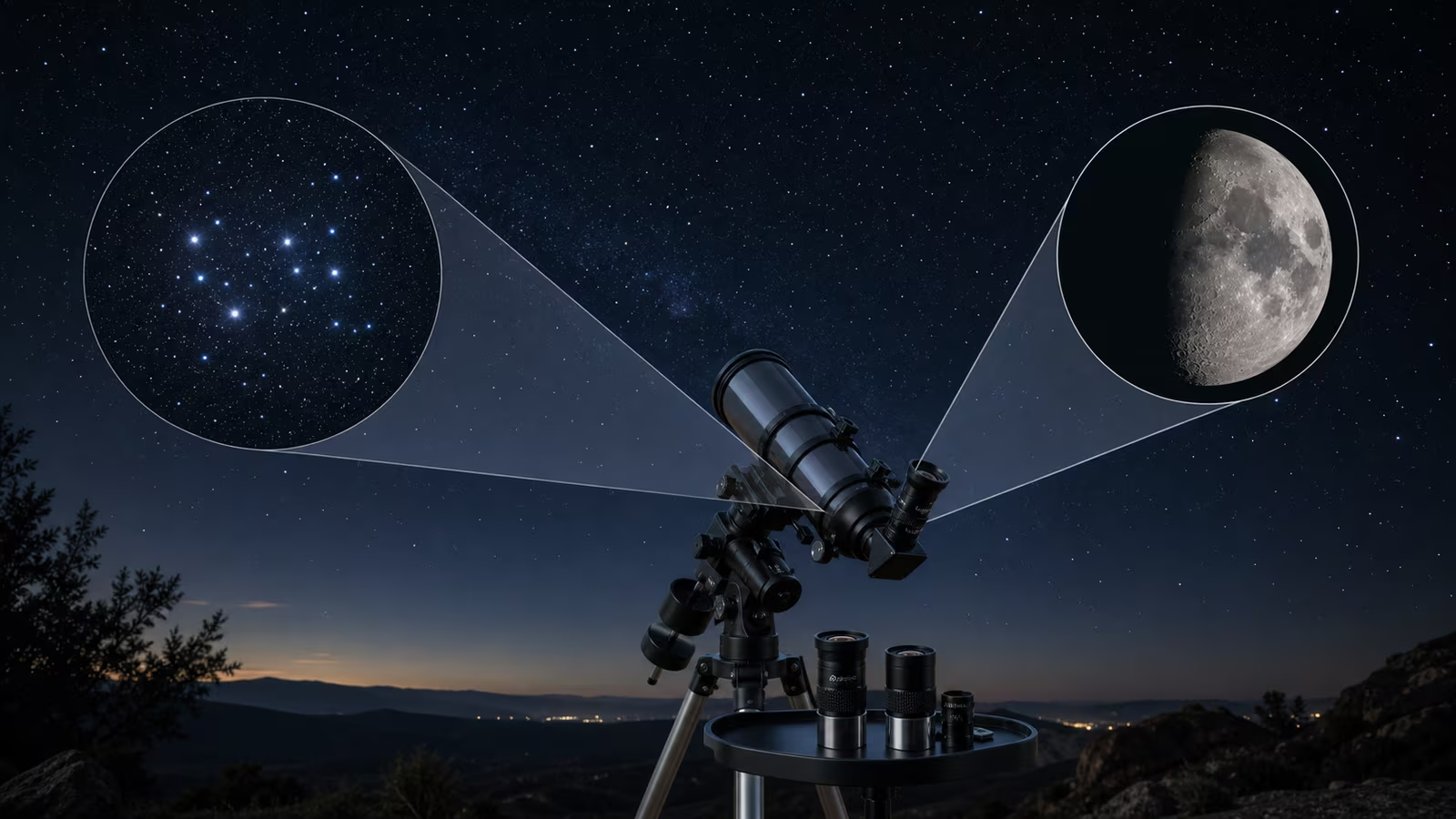
How Telescope Eyepiece Magnification Works
Telescope eyepiece magnification begins when the instrument’s main lens or mirror forms an image at its focal plane. The telescope focal length, normally listed on the tube or in its documentation, works with the eyepiece focal length to determine how large that image appears to your eye.
Magnification describes how much larger an object’s angular size appears through the telescope than to the unaided eye. Raising magnification can reveal finer detail, but it also reduces the field of view and can make the image dimmer or more affected by shake and atmospheric conditions.
For a telescope and eyepiece, the magnification formula is:
Telescope Eyepiece Magnification
M = F_t / F_e
where:
F_tis the telescope focal length (in millimetres).F_eis the eyepiece focal length (in millimetres).Mis the magnification (a unitless ratio, often written as “×”).
For example, a telescope focal length of 1000 mm paired with a 25 mm eyepiece gives:
M = 1000 / 25 = 40×
That telescope–eyepiece pairing makes objects appear about 40 times larger in angular size than with the unaided eye. Changing eyepieces changes the result: shorter focal length eyepieces raise magnification, while longer focal length eyepieces lower it and show a broader patch of sky.
Telescope Apparent and True Field of View
Telescope eyepiece specifications often state an apparent field of view (AFOV) in degrees. AFOV is roughly the angle your eye sees through the eyepiece itself, rather than the portion of sky shown by one particular telescope. Common values are around 40–50° for simple designs, 60–70° for wide-field eyepieces, and 80° or more for ultra-wide designs.
At the telescope, the more useful quantity is usually the true field of view (TFOV): the actual angular width of sky visible through the telescope–eyepiece combination. Because magnification enlarges the view, true field is smaller than apparent field.
This telescope calculator uses the widely used AFOV-to-magnification approximation:
Approximate Telescope True Field of View
TFOV ≈ AFOV / M
where:
AFOVis the apparent field of view of the eyepiece (in degrees).Mis the magnification calculated from the focal lengths.TFOVis the approximate true field of view on the sky (in degrees).
For example, an eyepiece with AFOV = 50° at 40× magnification gives:
TFOV ≈ 50 / 40 = 1.25°
This telescope setup would show a patch of sky about 1.25 degrees across—slightly more than twice the apparent diameter of the full Moon (about 0.5°).
Telescope Exit Pupil and Eyepiece Image Brightness
Telescope exit pupil can be calculated when you also know the aperture, or diameter, of the main lens or mirror. It is the diameter of the beam of light leaving the eyepiece and entering your eye.
For telescope viewing, exit pupil connects image brightness, contrast, and the apparent comfort of the view. With extended objects such as nebulae and galaxies, apparent surface brightness at the eyepiece depends strongly on exit pupil.
The telescope exit pupil is given by:
Telescope Exit Pupil
EP = D / M
where:
Dis the telescope aperture (in millimetres).Mis the magnification.EPis the exit pupil diameter (in millimetres).
Typical dark-adapted pupil diameters for adults range from about 5 mm to 7 mm, depending on age, lighting, and individual variation. If the calculated exit pupil is larger than your eye’s pupil, some light from the telescope does not reach your retina. If the exit pupil is very small (for example, 0.5–1 mm), the view can appear dim and eye floaters may be more noticeable.
For telescope eyepiece selection, observers often use these rough exit-pupil ranges:
- 4–6 mm: bright, wide-field views of large nebulae, open clusters, and Milky Way star fields.
- 2–3 mm: a useful compromise for many deep-sky objects, balancing brightness and contrast.
- 1–2 mm: a common range for lunar and planetary observing where higher magnification is wanted.
- < 1 mm: very high powers, mainly for tight double stars or occasional planetary detail when the atmosphere is extremely steady.
Interpreting Telescope Magnification Calculator Results
This telescope eyepiece calculator takes the optical dimensions that determine magnification, sky coverage, and exit pupil:
- Telescope focal length (in millimetres).
- Eyepiece focal length (in millimetres).
- Eyepiece apparent field of view (in degrees).
- Telescope aperture (optional, in millimetres) if you want the exit pupil.
From those telescope and eyepiece values, it returns:
- Magnification (
M), showing how many times larger objects appear than with the naked eye. - True field of view (
TFOV), the approximate patch of sky you see, measured in degrees. - Exit pupil (
EP), the diameter of the beam of light reaching your eye (shown only if you provide aperture).
Read the telescope outputs together rather than treating any one value as a complete recommendation:
- If magnification is very high but the exit pupil is tiny, the image may be dim and sensitive to poor atmospheric seeing.
- If the true field of view is very small but you want to frame a large object (for example, the Pleiades or the Orion Nebula), you may need a longer focal length eyepiece or one with a larger AFOV.
- If the exit pupil is larger than about 6–7 mm, you are probably not using the full light-gathering potential of your telescope.
Worked Telescope Eyepiece Example
Consider a telescope with:
- Telescope focal length
F_t = 1200 mm - Telescope aperture
D = 200 mm
Pair it with an eyepiece specified as:
- Eyepiece focal length
F_e = 20 mm - Apparent field of view
AFOV = 68°
Step 1: Telescope magnification
Use the magnification formula:
M = F_t / F_e = 1200 / 20 = 60×
The telescope–eyepiece combination gives 60 times magnification.
Step 2: Telescope true field of view
Apply the TFOV approximation:
TFOV ≈ AFOV / M = 68 / 60 ≈ 1.13°
You will see a patch of sky roughly 1.1 degrees across—about twice the width of the full Moon.
Step 3: Telescope exit pupil
Now calculate the exit pupil:
EP = D / M = 200 / 60 ≈ 3.3 mm
An exit pupil of about 3.3 mm is a comfortable size for many deep-sky objects, providing a useful balance of brightness and contrast.
Use the same telescope eyepiece process for any values: enter them above, then compare magnification, TFOV, and exit pupil against the target you want to observe, whether it is a planet, the Moon, a star cluster, a galaxy, or a wide-field region.
Example Telescope Eyepiece Combinations
This telescope eyepiece comparison uses a 1200 mm focal length, 200 mm aperture telescope and 68° AFOV eyepieces at several eyepiece focal lengths.
| Eyepiece Focal Length (mm) | Magnification (×) | True FOV (°) | Exit Pupil (mm) |
|---|---|---|---|
| 30 | 40 | 1.70 | 5.0 |
| 20 | 60 | 1.13 | 3.3 |
| 12 | 100 | 0.68 | 2.0 |
| 8 | 150 | 0.45 | 1.3 |
| 5 | 240 | 0.28 | 0.8 |
These telescope eyepiece results illustrate how changing only eyepiece focal length changes magnification, field of view, and exit pupil:
- At 30 mm, the telescope view is wide and bright, suited to large nebulae and sweeping star fields.
- At 12–8 mm, magnification and contrast increase, making this range useful for smaller galaxies, globular clusters, and lunar detail.
- At 5 mm, magnification is high and the exit pupil is small; the view will be sensitive to atmospheric stability but can show fine planetary or double-star detail when conditions allow.
Practical Telescope Eyepiece Observing Guidelines
Use the telescope magnification, true-field, and exit-pupil outputs to narrow down eyepiece choices for different astronomical targets:
- Wide-field and large objects (Milky Way, large open clusters, big nebulae): look for low magnification (large eyepiece focal length), true fields of view larger than about 1°, and exit pupils around 4–6 mm.
- General deep-sky observing (many galaxies and nebulae): a magnification range that gives 2–3 mm exit pupils is often a good starting point.
- Moon and planets: try magnifications that yield 1–2 mm exit pupils, adjusting based on how steady the atmosphere appears on a given night.
- Double stars and very small details: very high magnification (exit pupils below 1 mm) can be useful, but only when seeing conditions are excellent and the optics are well collimated.
Telescope Magnification Assumptions and Limitations
This telescope magnification calculator uses simplified optical relationships, so its eyepiece results should be read with the following limits in mind:
- Approximate TFOV formula: The relationship
TFOV ≈ AFOV / Mis an approximation that works reasonably well for many eyepieces. In reality, the exact true field is more accurately determined by the eyepiece’s field stop diameter and the telescope focal length. Some eyepiece designs or configurations may deviate from the simple estimate. - Ideal optics: The calculator assumes perfect, aberration-free telescope and eyepiece optics. It does not account for coma, field curvature, astigmatism, chromatic aberration, or other distortions that can affect edge sharpness and perceived field of view.
- Visual use only: The telescope results are intended for visual observing. For astrophotography, image scale, sensor size, and sampling are more relevant than eyepiece AFOV, and this tool does not model those factors.
- Units and values: All telescope inputs assume millimetres for focal lengths and aperture, and degrees for apparent field of view. Entering values in other units will produce incorrect results.
- Observer’s eye: Exit-pupil interpretations assume a dark-adapted human eye with typical pupil sizes. Individual eyes vary, and pupil size decreases with age. The calculator does not attempt to model these personal differences.
- Accessories not modeled: Additional optics, such as Barlow lenses, focal reducers, or binoviewers, change the effective focal length of the system. To use those configurations accurately, manually adjust the telescope focal length in the inputs to reflect the effective value.
- Atmospheric seeing and transparency: Telescope magnification calculations cannot account for the quality of the night sky. Poor seeing or light pollution can make very high magnifications impractical even if the numeric results look promising.
Because of these telescope-specific limits, use the outputs as observing-planning guidance rather than exact predictions. Compare eyepieces by their magnification, sky framing, and exit pupil, then let actual conditions at the eyepiece determine the final choice.
Telescope Eyepiece Field Arcade
This telescope eyepiece game uses the current calculator view: catch eyepieces that stay close to its true field and exit pupil, and skip combinations that do not.
Move the tray with touch, pointer, or arrow keys. Blue eyepieces fit the current view; orange eyepieces do not.