
Introduction to underground cable cover
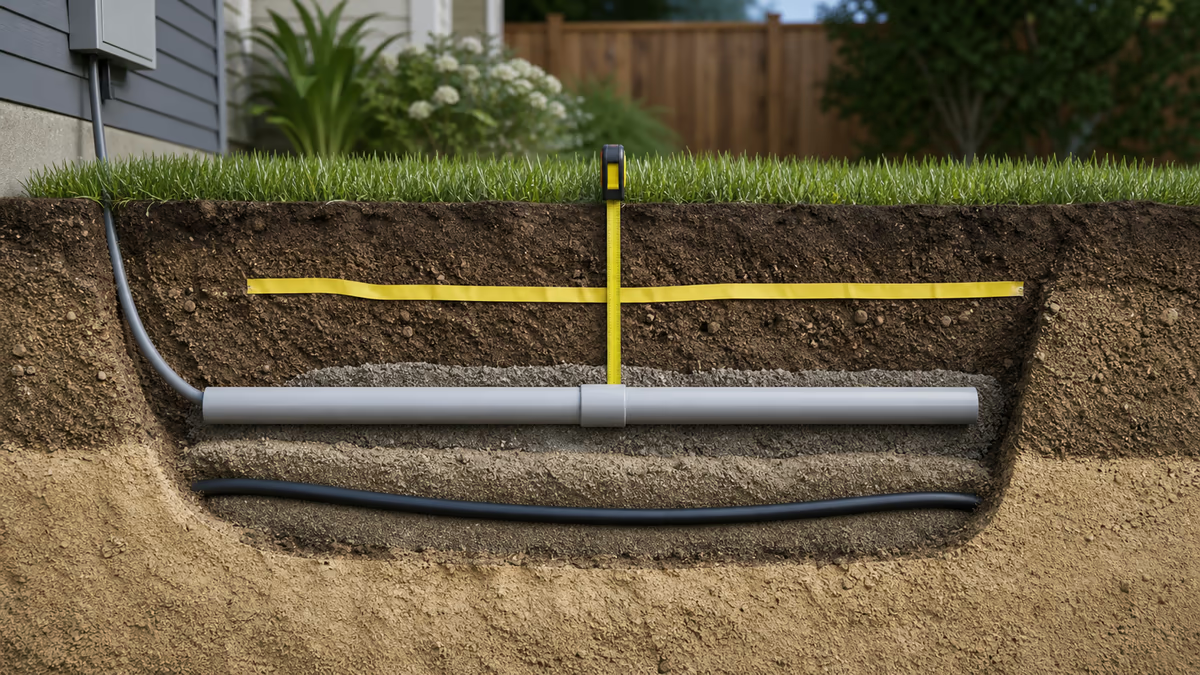
Underground cable cover is the vertical distance from finished grade to the top of the buried cable or raceway. It is not the distance to the trench floor. That distinction matters because a compliant trench must also accommodate the outside diameter of the cable or conduit and any bedding beneath it.
This calculator models the general structure of NEC Table 300.5 for circuits up to 1000 V. The result depends on both the wiring method and the location above the run. A direct-burial cable in a lawn, rigid metal conduit under the same lawn, and PVC beneath a commercial driveway can have different requirements. Special columns may apply to qualifying residential GFCI-protected branch circuits and identified circuits operating at 30 V or less.
The tool also includes planning estimates for fiber and circuits over 1000 V. Those branches require extra care: communications providers usually set fiber depth, while medium-voltage work is normally engineered and may fall under utility or NESC rules. Treat every result as a planning aid rather than permission to excavate or backfill.
How to use the cable burial depth calculator
Start with a preset when it closely matches the project, or leave the calculator on Custom. Choose the circuit type, wiring method, and location carefully because those selections identify the applicable table column and row. A private one- or two-family dwelling driveway is not the same category as a street, alley, commercial driveway, or public parking area.
Enter the nominal voltage and breaker or fuse rating. The modeled residential reduction requires a branch circuit at 120 V or less, GFCI protection, and overcurrent protection no greater than 20 A. Selecting “GFCI protected” does not reduce the result when those other conditions are absent.
Finally, describe the physical trench. Run length and trench width determine excavation volume. Outside diameter and bedding determine how far the trench floor must sit below the minimum-cover line. If frozen soil is selected, the entered frost line is treated as a minimum planning floor. Click the calculate button and read the warnings along with the headline number.
The burial-cover and trench formulas
The cover value comes from a lookup rather than a continuous equation. After the applicable cover is selected, total dig depth is calculated by adding the wiring-method diameter and bedding:
Plain-text condition rule: residential branch circuit, 120 V or less, GFCI protected, and 20 A or less may qualify for the residential column. It is not applied to 240 V circuits. In other words, this exception is not applied to 240 V circuits or other nonqualifying feeders.
Plain-text formula: digDepthIn = minimumCoverIn + outsideDiameterIn + beddingIn; trenchVolumeCuYd = lengthFt * (widthIn / 12) * (digDepthIn / 12) / 27.
Here, minimum cover is measured to the top of the cable or conduit, outside diameter is the full physical diameter, and bedding is the material below the run. Bedding above the cable may be useful for protection, but it does not replace required cover.
For a rectangular trench, excavation volume in cubic yards is:
Length is entered in feet, while width and depth are entered in inches. The estimate assumes straight vertical sides and a uniform width. Real excavations may require over-cut, bell holes, shoring, sloping, or benching. Loose soil also occupies more room than compact soil, so the calculator applies a planning swell factor of 25%.
Reference values used for ordinary NEC-style locations
The following compact reference shows common ordinary-location values. It does not reproduce every condition or note in the adopted code. Under traffic areas, buildings, concrete slabs, dwelling driveways, and airport runways, select the corresponding location in the calculator instead of relying on this short summary.
| Wiring or circuit method | Cover | Important condition |
|---|---|---|
| Direct-burial cable | 24 in. (600 mm) | Cable must be identified for direct burial and wet locations. |
| Rigid or intermediate metal conduit | 6 in. (150 mm) | Corrosion protection and approved fittings still apply. |
| Listed nonmetallic raceway | 18 in. (450 mm) | Conductors inside an underground raceway must be wet-location rated. |
| Qualifying residential 120 V GFCI branch circuit | 12 in. (300 mm) | Overcurrent protection must be 20 A or less. |
| Identified circuit of 30 V or less | 6 in. (150 mm) | The cable and circuit must satisfy the special-column conditions. |
Code tables use rounded metric partners such as 600 mm for 24 inches. Those are not exact mathematical conversions. The calculator preserves the table’s common soft-metric values for cover but converts physical trench dimensions at exactly 25.4 mm per inch.
Inches and millimetres in the trench result
The calculator distinguishes a code-table value from a measured physical dimension. A listed 24-inch cover value is displayed with its common 600 mm table partner. Total dig depth, however, may include decimal outside diameter and bedding, so it is converted exactly:
Excavation is shown in cubic feet, cubic yards, and cubic metres. These quantities describe the approximate hole, not the amount of bedding to purchase or the final haul-off weight. Water, soil density, side slopes, and machinery can change actual quantities substantially.
Worked example: a 120 V backyard receptacle
Suppose a 120 V, 20 A residential branch circuit supplies a backyard receptacle. It is GFCI protected and crosses an ordinary lawn in listed PVC conduit. The residential conditions are satisfied, so the special 12-inch cover column may be used for this modeled location instead of the ordinary 18-inch PVC value.
If the conduit has a 1.90-inch outside diameter and rests on 3 inches of sand, the trench floor is 12 + 1.90 + 3 = 16.90 inches below finished grade. For a trench 50 feet long and 8 inches wide, the rectangular excavation is about 46.9 cubic feet, or 1.74 cubic yards. With 25% swell, the loose spoil may occupy about 2.17 cubic yards.
Changing only one fact can change the answer. A 240 V feeder does not qualify for the 120 V residential reduction. A street or commercial parking crossing uses a traffic-area rule. A local amendment may require more cover than the national model. This is why the result includes its basis and warnings rather than presenting an isolated number.
Practical checks before opening the trench
Call 811 or the applicable local utility-location service before digging, even on private property. Mark the planned route and hand-dig near identified facilities. Obtain permits and confirm whether the underground work must remain exposed for inspection.
Use materials approved for wet locations. The inside of underground conduit is considered wet, so ordinary dry-location conductors are not sufficient. NM-B cable commonly called Romex is not a direct-burial cable. Protect the run where it emerges from grade, avoid sharp rocks against cable or raceway, and allow for frost movement and settlement.
- Confirm the adopted code edition and local amendments with the authority having jurisdiction.
- Verify conductor sizing, voltage drop, grounding, bonding, and raceway fill separately.
- Use warning tape where required and where it will provide useful advance notice to future excavators.
- Photograph the open trench with a visible tape measure and record offsets from permanent landmarks.
- Do not enter an unsafe trench. Excavations may require protective systems under OSHA rules.
Limitations of this underground cable estimate
This calculator is an educational summary, not the NEC, a permit, an engineered design, or an inspection decision. It does not model every table note, occupancy rule, classified location, pool or spa requirement, agricultural rule, utility standard, concrete-encased duct bank, or local amendment. Fiber values are planning conventions rather than electrical-code determinations.
The frost option uses the number entered by the user and does not determine the local frost line. The rock warning describes a general concept but does not design a concrete cap or raceway detail. The excavation model assumes a rectangular trench and a constant width. Always resolve conflicting requirements in favor of the adopted rule and the authority having jurisdiction.
Sources for underground wiring and excavation planning
Primary planning references include NFPA 70 Article 300.5 and its minimum-cover table, Article 300.50 for higher-voltage installations, the Canadian Electrical Code where it applies, local permit requirements, utility construction standards, and excavation-safety rules.
Underground cable burial questions
Is cover measured to the cable or the trench floor?
Cover is measured to the top of the cable or raceway. Add outside diameter and bedding to find the trench-floor depth.
Does conduit always permit a shallower trench?
No. Rigid metal conduit and PVC can reduce cover in some ordinary locations, but traffic-area rows can require the same cover for several wiring methods.
What happens when solid rock prevents normal burial?
Special raceway and concrete protection provisions may be available, but the detail must be confirmed with the authority having jurisdiction before construction.
Are fiber-optic depths taken from NEC Table 300.5?
Not generally. The network owner, right-of-way authority, utility requirements, and local permits normally govern communications depth.
Safety reminder for buried electrical work
Underground electrical work can expose people to shock, arc, fire, cave-in, and utility-strike hazards. De-energize and verify circuits, use appropriate protective equipment, and hire a licensed electrician where required. Never backfill before a required inspection.