
Introduction to tangential velocity and rim speed
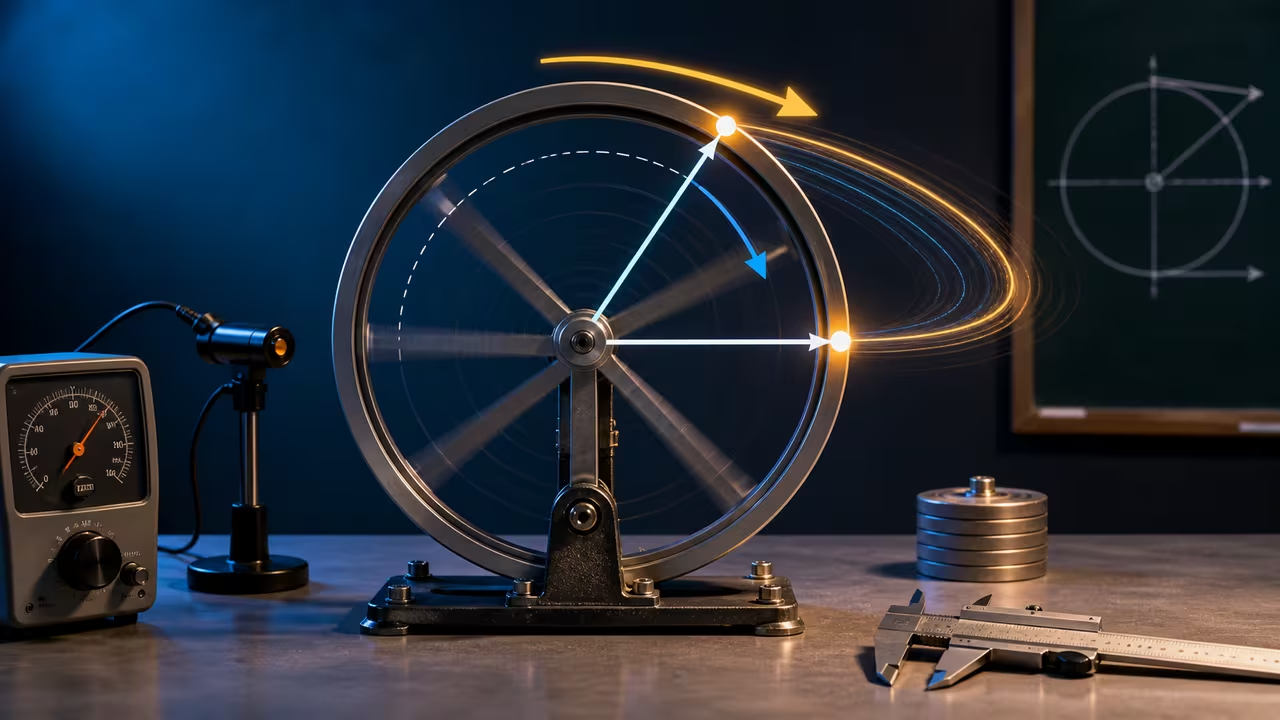
Tangential velocity is the linear speed of a point that is being carried around a circular path by a rotating body. Watch the tip of a fan blade, a chalk mark on a bicycle wheel, the outer groove of a record, a grinding wheel at the bench, or a city on the rotating Earth: each of those points travels a real distance through space every second, and that distance per second is the tangential speed. The word tangential records the direction. At any instant the velocity vector lies along the tangent to the circle, perpendicular to the radius, and it never points inward toward the axis — that inward direction belongs to the acceleration, not the velocity.
This page ties together the three quantities that describe that motion: tangential speed v, angular speed ω, and radius r, the perpendicular distance from the rotation axis to the point you care about. Angular speed answers “how fast is it turning?” and is the same everywhere on a rigid body; tangential speed answers “how fast is this particular point moving?” and grows with distance from the axis. The radius is the exchange rate between the two. A point twice as far from the axle sweeps twice the arc in the same time, so it moves twice as fast even though the shaft turns at one single rate. That is why the rim of a large flywheel can be supersonic while the hub is nearly still.
The relationship is short enough to do in your head once the units cooperate, and that caveat is the reason this calculator exists. Real inputs almost never arrive in coherent SI units. A motor nameplate says 1750 r/min, a servo datasheet says 90 deg/s, an astronomy problem gives a rotation period in hours, a drawing gives a diameter in millimetres or inches, and a safety limit is quoted in surface feet per minute. Every one of those needs a conversion factor before can be applied, and getting a factor wrong is far more common than getting the physics wrong. The unit menus beside each field here do those conversions explicitly, so you can enter the number you actually have.
Enter any two of the three quantities, leave the third blank, and the solver rearranges the same equation to fill in the gap. Give it radius and angular speed and it returns tangential speed; give it speed and radius and it returns angular speed; give it speed and angular speed and it returns the radius at which that combination occurs. Alongside the answer it reports the equivalent value in every supported unit, the rotation period, the revolutions per minute, and — clearly separated, because the two are constantly confused — the centripetal acceleration that the same rotation implies. The result is meant for homework checks, lab work, belt and pulley estimates, machine-tool surface speeds, turbine and fan tip speeds, centrifuge specifications, and any other place where an angular rate has to be turned into a linear one.
How to use the mixed-unit solver on this page
The form takes three rows, each with a number box and its own unit menu. Fill in exactly two rows, choose the unit that matches the number you actually have, and leave the third number box empty. The page recalculates as you type and again when you press the compute button, so there is never a stale answer sitting under a changed input.
- Radius r accepts metres, centimetres, millimetres, kilometres, inches, or feet. It is the perpendicular distance from the rotation axis to the point of interest — halve a diameter before entering it.
- Angular speed ω accepts rad/s, revolutions per minute (rpm), degrees per second, revolutions per second, or a rotation period T in seconds. Choosing the period switches the engine to internally.
- Tangential speed v accepts m/s, km/h, mph, ft/s, or ft/min (the surface-speed unit used on machine-tool charts).
- Leave the unknown field blank. Filling all three, or filling fewer than two, produces an explicit message rather than a guess.
- The presets load a realistic scenario in one click, including one that uses rpm and one that uses a rotation period, so you can see the conversions applied.
Every answer is reported in all of the supported units at once, so you never have to convert the output by hand. The result panel also shows a radius sensitivity sweep: the same angular speed evaluated at a quarter, a half, three quarters, and one and a quarter of your radius. That column is the quickest way to see the strict linearity of the relationship and to judge how much a manufacturing tolerance on the radius moves the rim speed.
Zero is handled deliberately rather than accidentally. A radius of zero is legitimate when you are solving for speed, and the tool returns exactly 0 m/s because a point sitting on the axis does not translate. Zero is refused wherever it would land in a denominator: solving for ω needs a strictly positive radius, solving for r needs a strictly positive angular speed, and the period input refuses T = 0 because that would demand an infinite rotation rate. Negative entries and non-numeric text are rejected with a message that names the offending field, and no result is ever produced from an input the calculator could not read.
The tangential velocity formula, its rearrangements, and the unit factors
For a rigid body in circular motion, the magnitude of the tangential velocity of a point at distance r from the axis is
Formula: v = ω r
with v in metres per second, ω in radians per second, and r in metres. The equation follows directly from the definition of angular measure: an angle in radians is arc length divided by radius, so , and differentiating with the radius held constant gives , which is exactly v = ωr. The two rearrangements the calculator uses are and .
The radian is the reason the formula has no stray constant in it. NIST’s Guide for the Use of the International System of Units classifies the radian as a dimensionless derived unit — a special name for the number one — so multiplying rad/s by metres yields metres per second with no conversion factor at all. Feed the same equation a value in degrees per second or revolutions per minute and it silently returns nonsense, because those units are the number one multiplied by something that is not one. That single fact is the source of most wrong answers on this topic, and it is why a calculator that accepts rpm and multiplies it straight by a radius is broken.
The exact conversions, taken from the NIST conversion tables, are: for a rotation rate n in r/min (the tabulated factor is 1 r/min = 1.047 198 × 10−1 rad/s), for degrees per second (1° = π/180 rad = 1.745 329 × 10−2 rad), and for a rotation period T in seconds. Substituting the last of these into v = ωr gives the period form of the same law,
Formula: v = (2 π r) / T
which simply says that one revolution covers a circumference of 2πr in one period. It is undefined at T = 0, and the calculator refuses that input rather than returning an infinity. On the length side the exact factors are 1 in = 2.54 × 10⁻² m and 1 ft = 3.048 × 10⁻¹ m, both exact by definition; on the speed side, 1 mph = 4.4704 × 10⁻¹ m/s exactly and 1 km/h = 1/3.6 m/s exactly.
Mixing up radius and diameter remains the most expensive mistake available here, because it is a clean factor of two that looks perfectly plausible in the output. A 700 mm wheel has r = 0.350 m, not 0.700 m. Scale errors are the second family: 35 cm is 0.35 m, 80 mm is 0.08 m, and an answer that is wrong by a tidy factor of 10, 100, or 1000 is almost always a decimal-point problem rather than a physics problem. Choosing the right unit in the menu removes both classes of error from the arithmetic, though it cannot tell you whether the number you measured was a radius or a diameter.
Worked example: a 700 mm grinding wheel at 850 rpm
A bench grinder carries a wheel of nominal diameter 700 mm and the spindle is rated at 850 r/min. The shop wants the rim speed in m/s to compare with the wheel’s marked maximum operating speed. Start by halving the diameter: r = 0.350 m. Then convert the rotation rate, which is not an angular speed in the sense the formula needs:
rad/s. Now apply the formula:
m/s, which is 112.2 km/h, 69.69 mph, 102.2 ft/s, or 6133 surface feet per minute. Notice what happens if the rpm figure is used directly: 850 × 0.350 would give 297.5, a number about 9.55 times too large, and 9.55 is exactly 60/2π. That is the entire failure mode of an rpm-unaware calculator, and it is why this page asks which unit your number is in instead of assuming.
The same run reports the rotation period, T = 60/850 = 0.0706 s, and the centripetal acceleration that the rim material must survive, m/s², about 283 g. That acceleration, not the speed itself, is what generates the hoop stress that bursts an over-sped abrasive wheel, which is why manufacturers mark a maximum operating speed and why it must never be exceeded.
The reverse problem is just as common. A belt runs over a pulley of radius r = 0.08 m at a measured line speed of v = 1.6 m/s. Then
rad/s, which the calculator also reports as 190.99 r/min and a period of 0.3142 s — figures you can hold against a tachometer reading or a motor nameplate. Solving in the third direction, a turntable running at ω = 3 rad/s that shows a measured surface speed of v = 0.9 m/s at some point puts that point at m from the spindle.
A third example exercises the period input and very small angular speeds. Earth completes one rotation relative to the stars in a sidereal day of 86 164.09 s, so ω = 2π/86 164.09 = 7.2921 × 10⁻⁵ rad/s. Using the WGS 84 equatorial radius of 6 378 137 m, the tangential speed of a point on the equator is 7.2921 × 10−5 × 6 378 137 ≈ 465.1 m/s, or about 1674 km/h. Select “rotation period (s)”, enter 86164.09, set the radius unit to kilometres and enter 6378.137, and the calculator returns that value directly. It is a good stress test of the display as well as the physics: an angular speed of 7.29 × 10⁻⁵ rad/s must not be rounded away to zero, which is exactly what a naive three-decimal formatter would do.
The comparison table below is a sanity-check aid rather than a second calculator. Because v is strictly proportional to both ω and r, doubling either input doubles the answer, and the rpm column shows how far a familiar-looking rotation rate is from the rad/s figure the formula needs.
| Setting | r (m) | ω (rad/s) | n (rpm) | v (m/s) | v (km/h) |
|---|---|---|---|---|---|
| Ceiling fan tip | 0.60 | 15.71 | 150 | 9.42 | 33.9 |
| Bicycle wheel at 25 km/h | 0.34 | 20.42 | 195 | 6.94 | 25.0 |
| Bench grinder rim | 0.35 | 89.01 | 850 | 31.15 | 112.2 |
| Vinyl record outer groove | 0.146 | 3.49 | 33.33 | 0.51 | 1.83 |
| Earth’s equator | 6 378 137 | 0.0000729 | 0.000696 | 465.1 | 1674 |
Reading the result: rim speed is not acceleration
The number the calculator returns is a speed, the magnitude of a vector that points along the tangent. Interpreting it usually means comparing it with a limit. For a rolling tyre that is not slipping, the rim’s tangential speed equals the vehicle’s road speed, so 31 m/s at the tread means 112 km/h down the road. For a machine tool it is the cutting or surface speed that feeds directly into feed-and-speed tables. For an abrasive wheel or a fan it is the quantity the manufacturer caps. For a centrifuge it is an intermediate step toward the relative centrifugal field.
Three quantities get conflated with tangential velocity often enough to be worth stating separately. Centripetal acceleration is , measured in m/s² and directed inward toward the axis. It is present even in perfectly uniform rotation, because the velocity is changing direction, and the calculator reports it as a clearly labelled secondary figure. Tangential acceleration is , where α is angular acceleration in rad/s²; it is zero for steady rotation, it is not computable from ω alone, and this page does not attempt it. Angular velocity ω is not a speed at all, has units of rad/s rather than m/s, and is the same for every point on the body.
The radius sweep in the result panel makes the practical consequence visible. Because the relation is linear, a 2% error in the radius produces a 2% error in the reported speed and a 4% error in the centripetal acceleration, since the latter goes as ω²r for a fixed rotation rate but as v²/r when the speed is what is held fixed. If your computed answer does not track that linearity when you nudge an input, the cause is almost always a unit selection rather than the physics.
Limitations and assumptions behind this rigid-body model
The equation v = ωr is exact, but it is exact for a specific idealisation, and every assumption in that idealisation is a limitation of this calculator. The most important ones, stated plainly:
- Rigid body, fixed axis. The radius is assumed constant while the body turns. Belts that stretch, blades that cone under load, tyres that deform at the contact patch, and elastic rotors that grow at speed all violate this to some degree, and the true rim speed then differs from the computed one.
- Magnitudes only, no direction. The tool returns the magnitude of the tangential velocity. It does not model sense of rotation, sign conventions, the vector form v = ω × r, or motion of the axis itself. Negative inputs are rejected rather than reinterpreted.
- Perpendicular distance, not slant distance. r must be measured perpendicular to the rotation axis. For a point on a sphere at latitude φ the correct radius is R cos φ, not R; using the full radius overstates the speed everywhere except the equator.
- Instantaneous values. For non-uniform rotation the result is a snapshot at the instant ω has the entered value. Spin-up and spin-down involve angular acceleration α, and the associated tangential acceleration at = αr is outside this calculator’s scope.
- No rolling-contact assumptions are made for you. Equating rim speed to vehicle speed is valid only when there is no slip. Under wheelspin, lock-up, or belt slip the two numbers diverge, and the calculator has no way to detect that.
- Classical, non-relativistic. The linear relation holds in the Newtonian regime used throughout engineering practice; it is not applied to speeds approaching c.
- Floating-point precision. Results are computed in IEEE-754 double precision and displayed to six significant figures. Values below about 10−4 or above 1012 are shown in scientific notation so that small angular speeds are never rounded to a misleading zero.
- Not a safety authority. The centripetal acceleration and rim speed figures are physics, not clearance to run a machine. Maximum operating speeds for wheels, rotors, fans, and centrifuge rotors come from the manufacturer’s marking and the applicable safety standard, never from a web calculator.
One assumption is worth restating because it is invisible: the calculator assumes you have told it the truth about your units. It can convert 850 r/min into 89.012 rad/s flawlessly and still give a wrong answer if the 850 was actually degrees per second, or if the 0.700 you entered was a diameter. Unit menus remove arithmetic slips, not measurement mistakes.
Questions people ask about tangential speed
Why must angular speed be in radians per second for v = ωr?
Because the radian is a dimensionless derived unit, ω in rad/s multiplied by r in meters gives meters per second directly with no extra factor. Degrees per second and revolutions per minute each carry a numerical factor, so they must be converted first: 1 rpm = 2π/60 rad/s and 1 deg/s = π/180 rad/s.
How do I convert rpm to rad/s before applying the formula?
Multiply the rpm figure by 2π and divide by 60, because one revolution is 2π radians and one minute is 60 seconds. NIST gives the factor as 1 r/min = 0.1047198 rad/s, so 850 rpm is about 89.01 rad/s. The unit menu on this page performs that conversion for you.
Can I enter a rotation period instead of an angular speed?
Yes. Pick the period option and the calculator applies ω = 2π/T, which reduces the whole problem to v = 2πr/T. A period of zero is rejected with an explicit message because it would divide by zero and imply an infinite angular speed.
Is tangential velocity the same as centripetal or tangential acceleration?
No. Tangential velocity v = ωr is a speed in m/s pointing along the tangent. Centripetal acceleration a_c = v²/r = ω²r is an acceleration in m/s² pointing toward the axis, and tangential acceleration a_t = αr needs the angular acceleration α rather than the angular speed ω.
What happens if the radius or the angular speed is zero?
A zero radius is accepted when you solve for tangential speed and correctly returns v = 0 m/s, because a point on the rotation axis does not move. Zero is rejected when it would sit in a denominator: ω = v/r needs r greater than zero, and r = v/ω needs ω greater than zero.
Can I enter a diameter instead of a radius?
Not directly. The formula uses the distance from the rotation axis to the point of interest, so halve any diameter before entering it. Typing a diameter by mistake doubles every tangential speed the calculator reports, which is the single most common error on this kind of problem.
Sources for the equations and conversion factors
The physics and every numerical factor used by this page are taken from the following primary references. The tangential/centripetal decomposition and the relations v = ωr, at = αr, and ac = v²/r = ω²r follow OpenStax, University Physics Volume 1, Chapter 10 (Fixed-Axis Rotation), an openly licensed peer-reviewed text (openstax.org — 10.1 Rotational Variables).
The status of the radian as a dimensionless SI derived unit — a special name for the number one — is from NIST Special Publication 811, Guide for the Use of the International System of Units (SI), Chapter 4 (nist.gov — NIST Guide to the SI, Chapter 4). The accepted non-SI values 1 min = 60 s and 1° = (π/180) rad are from NIST Special Publication 330, The International System of Units (SI), Section 4 (nist.gov — SP 330 Section 4).
The exact conversion factors 1 in = 2.54 × 10⁻² m, 1 ft = 3.048 × 10⁻¹ m, 1 mph = 4.4704 × 10⁻¹ m/s, and 1 r/min = 1.047 198 × 10−1 rad/s are from NIST SP 811 Appendix B.9, Factors for Units Listed Alphabetically (nist.gov — NIST Guide to the SI, Appendix B.9). The standard acceleration of gravity used to express results in multiples of g is the defined value gn = 9.806 65 m/s² listed in the same appendix. The Earth example uses the WGS 84 equatorial radius of 6 378 137 m and a sidereal rotation period of 86 164.09 s; that radius is a defining parameter of the WGS 84 reference ellipsoid.
Orbit Sync mini-game
Want a fast way to build intuition for v = ωr? This optional mini-game turns the same idea into a quick decision challenge. Each round shows an angular speed and a target tangential speed. Tap or click the orbit lane with the radius that makes the courier hit the correct speed before it reaches the glowing gate. It does not change the calculator result above; it simply makes the relationship between radius, angular speed, and tangential speed easier to feel.