At the Edge of Understanding
Physics began with ordinary astonishment: falling bodies, swinging lamps, magnets, lenses, tides, and the wandering lights of planets. The deeper the measurements became, the less ordinary the world looked. Matter behaved like probability. Time slowed near mass and speed. Empty space acquired structure. Galaxies fled from one another through expanding spacetime. The universe did not become less lawful as it became stranger. It became more precise.
This guidebook is a tour of that precision at the edge of imagination. It does not treat every speculative idea as equally plausible, and it does not turn science fiction into engineering advice. Instead, it asks a better question: if an idea can be written in the language of physics, what do the numbers demand? A warp metric may fit on a page while requiring impossible energy. A quantum thought experiment may sharpen a philosophical problem without becoming a practical instruction. A cosmic catastrophe may be mathematically describable and still irrelevant on human timescales.
Two categories of strangeness appear here. The first includes phenomena that are genuinely established but counterintuitive: quantum entanglement, time dilation, vacuum energy, the expansion of space. These are not speculation; they are confirmed by precision experiments and underlie technologies from GPS to MRI machines. The second category includes speculative extensions such as warp drives, traversable wormholes, and simulation hypotheses. They remain theoretically interesting, but they face enormous obstacles and may prove impossible. Both deserve exploration, and the calculators help distinguish what is known from what is merely mathematically possible.
Approach this guidebook as a disciplined sandbox. Change one input at a time. Notice which outputs barely move and which explode by orders of magnitude. Ask whether a result is limited by energy, information, causality, entropy, measurement, or time. The calculators are teaching aids rather than engineering documents, but they reveal a useful habit of mind: the first defense against fantasy is not cynicism. It is scale.
Some concepts discussed here, including quantum suicide thought experiments and cosmic doom scenarios, can sound disturbing. They are included only for philosophical and scientific context. The same physics that names frightening possibilities also tells us why most of them are fantastically remote, constrained, or merely speculative. Curiosity belongs here. Recklessness does not.
Quantum Paradoxes: Where Intuition Fails
Quantum mechanics is not just a different theory of matter. It is a different grammar for reality. In the classical picture, objects carry definite properties whether anyone looks or not. In the quantum picture, the state of a system is a structured set of possibilities, and measurement is one of the ways those possibilities become the single result we can record. The theory is strange because experiments force it to be strange.
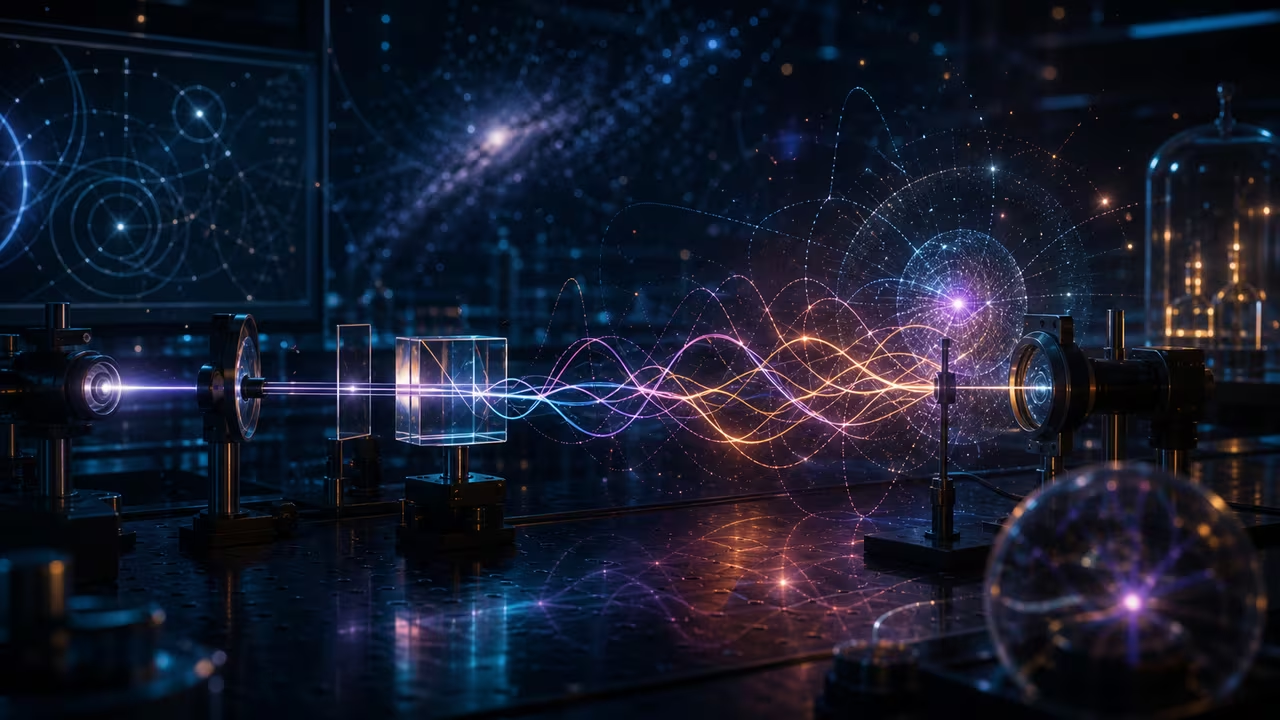
The weirdness begins with the wavefunction, a mathematical object that encodes the probabilities of possible measurement outcomes. Before measurement, a particle's position is not merely unknown. It is represented as a distribution of possibilities spread through space. Upon measurement, the system yields a specific value. How and why that transition should be understood remains one of physics' deepest mysteries, with competing interpretations ranging from observer-induced collapse to many-worlds branching to decoherence-based explanations.
Quantum entanglement extends the strangeness across arbitrary distances. Two particles prepared together can share quantum states such that measuring one instantly determines properties of the other, regardless of separation. Einstein called this "spooky action at a distance," suspecting hidden variables that predetermined outcomes. But Bell's theorem and subsequent experiments proved that no local hidden variable theory can reproduce quantum predictions. The universe is genuinely non-local in some sense, though this cannot be used to transmit information faster than light.
The practical lesson is restraint. Quantum language is often borrowed to decorate claims about consciousness, luck, healing, or destiny. Real quantum mechanics is more demanding and more interesting. It gives accurate probabilities, imposes strict experimental rules, and punishes sloppy metaphor. The calculators in this section are most useful when they keep that discipline visible.
The Casimir effect demonstrates that quantum weirdness has physical consequences. Two uncharged, parallel metal plates in a vacuum experience a tiny attractive force because the plates restrict which virtual particles (quantum fluctuations) can exist between them. The vacuum itself is not empty but seethes with momentary particle-antiparticle pairs, and boundary conditions affect this seething. The force has been measured precisely and matches quantum electrodynamic predictions.
Quantum computing exploits superposition and entanglement to perform certain calculations vastly faster than classical computers. Quantum states are fragile, though. Interaction with the environment causes decoherence, collapsing superpositions and destroying the quantum advantage. The battle against decoherence drives quantum computing research, requiring extreme isolation, error correction, and ever more sophisticated engineering. The calculators below let you explore how noise accumulates, how quickly coherence decays, and what measurements reveal about the quantum realm.
Quantum Immortality Survival Measure Calculator
Explore how measure (your share of existence in many-worlds) dwindles through repeated quantum gambles.
Quantum Error Rate Estimator
See how noise accumulates and derails fragile quantum computations over time.
Casimir Force Calculator
Calculate the vacuum-induced pressure between closely spaced parallel plates.
Bell Violation Significance Calculator
Analyze coincidence counts from a Bell test and quantify violation of classical bounds.
Quantum Zeno Time Extension Calculator
Model how frequent measurements can freeze an unstable quantum state's decay.
Qubit Decoherence Time Calculator
Estimate how quickly superposition states lose phase coherence in realistic conditions.
The Simulation Hypothesis: Are We Running on Cosmic Hardware?
The simulation hypothesis proposes that what we experience as reality might be a computer simulation created by a more advanced civilization. It is an old philosophical worry dressed in modern computational clothing. Nick Bostrom's trilemma suggests that at least one of the following is true: civilizations go extinct before developing simulation capability, advanced civilizations choose not to run ancestor simulations, or we are almost certainly living in a simulation ourselves.
The argument's logic is statistical. If advanced civilizations can and do run many simulations of past civilizations, simulated beings vastly outnumber "real" ones. Given no way to determine which category we belong to, Bayesian reasoning suggests we are probably simulated. The argument does not prove we are simulated. Technological barriers may prevent realistic simulations, advanced civilizations may find them uninteresting, or the assumptions may be wrong. Still, the hypothesis is useful because it forces a clean conversation about computation, evidence, and what would count as a test.
Physical constraints set limits on any simulation. Memory requirements scale with the volume of simulated space and the resolution of detail maintained. Bandwidth requirements scale with the rate of events and interactions. Consistency requirements explode combinatorially when many agents interact simultaneously. A simulator might economize by rendering only observed regions at high resolution, as video games do with level-of-detail systems. Physics, however, imposes subtle consistency checks that could make such shortcuts detectable in principle.
The Landauer limit establishes the minimum energy cost of computation. Erasing one bit of information requires at least kT ln(2) joules of energy, where k is Boltzmann's constant and T is temperature. For any finite energy budget, a simulation has finite computational capacity. Running a simulation of our universe at the resolution of quantum mechanics for billions of years would require energy budgets beyond our ability to comprehend unless the simulators cut corners we cannot detect.
This is where the hypothesis becomes most interesting. A simulated world would still need rules, resources, and accounting. It would need memory or something equivalent to memory. It would need a way to preserve correlations well enough that observers do not see contradictions. Even speculation has a budget.
What would evidence for simulation look like? Perhaps resolution limits at small scales (Planck length already exists), quantization of physical properties (many are quantized), or glitches in physical law. So far, physics shows no such cracks. Absence of evidence is not evidence of absence, but a claim that cannot name the evidence that would change its mind is scientifically weak. The simulation hypothesis remains unsatisfying as physics while remaining useful as a pressure test for ideas about computation, reality, and knowledge.
Simulation Memory Budget Calculator
Estimate the storage needed to model a region of universe at various resolutions.
Simulation Reset Detection Calculator
Model the probability of detectable resets or rollbacks in a simulated reality.
Omega Point Computation Capacity Calculator
Explore theoretical computational capacity available at the universe's ultimate limit.
Landauer Bit Erasure Energy Calculator
Calculate the thermodynamic minimum energy cost of erasing bits of information.
Render Budget vs. Observer Density Calculator
Explore how computational limits constrain simultaneous observers and rendering resolution.
Bending Space and Time: Relativistic Extremes
Einstein's general relativity revealed gravity as geometry. Mass and energy tell spacetime how to curve, and curved spacetime tells matter and light how to move. The idea sounds serene until the numbers become extreme. Near black holes, neutron stars, and the early universe, geometry stops feeling like a background and becomes the main event.
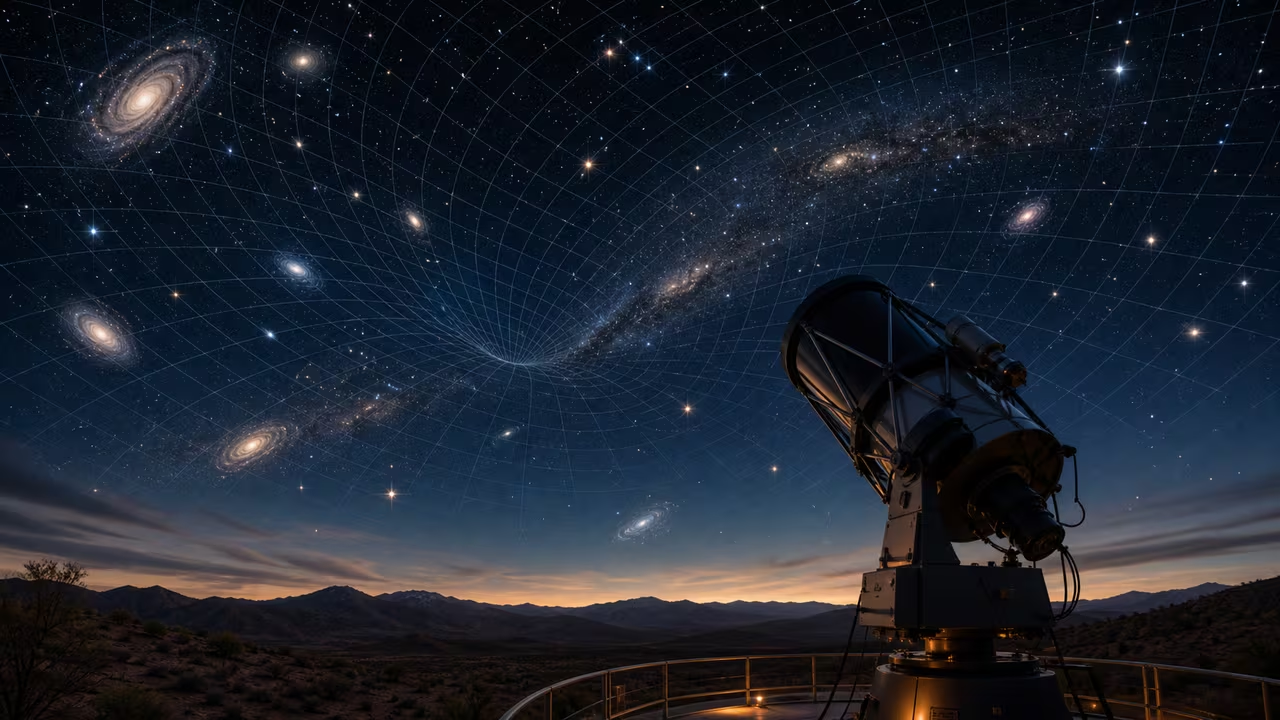
Extreme curvature produces extreme phenomena. Black holes curve spacetime so severely that nothing, not even light, can escape once past the event horizon. Time dilation near the horizon becomes infinite from an outside observer's perspective; an infalling observer would experience finite time to the singularity but watch the outside universe's future flash by. These are not speculations but consequences of well-tested equations, confirmed by observations of stellar-mass and supermassive black holes throughout the universe.
General relativity permits geometries even stranger than black holes, at least mathematically. Wormholes connect distant points in spacetime through tunnels that could (in principle) allow faster-than-light travel without locally exceeding light speed. The Alcubierre metric describes a warp bubble that compresses space ahead and expands it behind, carrying a ship faster than light relative to distant observers while remaining stationary relative to local space. The Krasnikov tube creates a permanent tunnel along a previously traveled path.
These ideas are useful precisely because they are so demanding. They separate "not forbidden by one equation" from "available to a civilization." A metric can be mathematically legal while requiring matter no one has seen, energy no star system could provide, or stability conditions that collapse under the first disturbance. Strange geometry teaches caution as well as wonder.
The catch is energy. These exotic geometries require negative energy densities, meaning regions where energy is lower than the ordinary vacuum. Quantum field theory allows brief negative energy fluctuations, but quantum inequalities strictly limit their magnitude and duration. Stabilizing a macroscopic wormhole would require Jupiter-masses of exotic matter with negative energy density. We have never observed such matter, and it may not exist. The Alcubierre warp drive requires energy equivalent to a substantial fraction of the observable universe's mass-energy. These are not engineering challenges in the usual sense. They may be physical impossibilities wearing the costume of equations.
Yet exploring these geometries mathematically reveals deep truths about physics. The constraints that make warp drives impractical tell us something about the structure of spacetime. The instabilities that collapse wormholes reveal how the universe protects causality. Even impossibilities are informative because they map the boundaries of what physics permits. The calculators below let you explore these boundaries by plugging in numbers and seeing what the equations demand.
Alcubierre Warp Energy Calculator
Compute the exotic negative energy required to create a warp bubble at various velocities.
Krasnikov Tube Travel Calculator
Explore travel times through a spacetime tunnel laid down by a near-light-speed journey.
Kugelblitz Black Hole Energy Calculator
Calculate the laser energy required to create a black hole from concentrated light alone.
Gravitational Time Dilation Calculator
Compare clock rates near massive bodies versus distant observers in flat spacetime.
Traversable Wormhole Exotic Matter Calculator
Estimate the exotic matter requirements for maintaining a traversable wormhole.
Cosmic Doom Scenarios: How the Universe Might End
The universe began with the Big Bang 13.8 billion years ago and has been expanding ever since. But how will it end? Different cosmological models predict different fates, ranging from eternal expansion into cold emptiness to catastrophic collapse or sudden phase transitions. Understanding these scenarios requires grappling with dark energy, entropy, and the stability of the quantum vacuum. These are frontier concepts, which means the answers are provisional but the questions are sharp.
Heat death represents the universe's most likely fate if current expansion continues. As space expands, matter dilutes, stars burn out, and black holes evaporate through Hawking radiation over unimaginable timescales. Eventually, the universe reaches maximum entropy, a state of near-perfect uniformity where no usable energy gradients remain. No stars, no planets, no life, no computation. Only a thin haze of particles drifting ever farther apart in eternal, cold darkness.
The Big Rip offers a more dramatic ending. If dark energy strengthens over time (equation of state parameter w < -1), the accelerating expansion eventually overcomes all forces binding structures together. First galaxy clusters separate, then galaxies fly apart, then solar systems unbind, then planets and stars shred, and finally atomic nuclei and particles themselves tear asunder. This occurs at a finite time in the future, possibly tens of billions of years from now if the parameters take certain values.
Vacuum decay presents the most sudden doom. Our universe's vacuum may not be the lowest possible energy state. It might be metastable, like a ball resting in a valley that could tunnel through a barrier to a lower valley. If a bubble of true vacuum nucleates anywhere, it expands at light speed, converting everything it touches to the new vacuum state. Inside, the laws of physics differ; atoms as we know them cannot exist. No warning would arrive before the bubble because it travels at the same speed as any signal.
Other scenarios include the Big Crunch (expansion reverses and the universe collapses), Big Bounce (collapse triggers a new expansion), and various multiverse-related possibilities. Each has distinct probabilities based on measured cosmological parameters. Current observations favor eternal expansion, suggesting heat death as the likeliest endpoint. But "likely" spans billions of years, leaving ample time for understanding to evolve and perhaps for intelligence to influence cosmic destiny.
The value of these scenarios is not that they predict a calendar date for doom. They teach which pieces of the universe matter most. Change the behavior of dark energy, and the ending changes. Change the stability of the vacuum, and the rules of matter become conditional. Change the long-term fate of black holes, and information itself becomes part of the story. Cosmology is where measurement becomes narrative.
Big Rip Cosmological Countdown Calculator
Estimate when runaway expansion might tear apart galaxies, planets, and atoms.
Quantum Vacuum Decay Risk Calculator
Gauge the probability that a true-vacuum bubble destroys our observable universe.
Cosmic Censorship Violation Probability Calculator
Estimate the likelihood of detecting a naked singularity in astronomical observations.
Baby Universe Nucleation Probability Calculator
Explore scenarios where high-energy events spawn entirely new universes.
Boltzmann Brain Emergence Calculator
Compare observer production via thermal fluctuations versus ordinary cosmological history.
Gamma-Ray Burst Lethality Radius Calculator
Calculate the minimum safe distance from gamma-ray bursts of various energies.
Extraterrestrial Futures: Civilizations Beyond Earth
If humanity survives the next few centuries without destroying itself or being destroyed by natural catastrophe, our descendants may spread beyond Earth to the solar system and eventually to other stars. The timescales of cosmic evolution dwarf human history. The galaxy is ten billion years old, which is plenty of time for expansion across its hundred thousand light-year diameter. This raises the famous Fermi paradox: where is everyone else?
Self-replicating probes offer a mechanism for galactic exploration without biological colonization. A Von Neumann probe would travel to another star system, mine local resources to construct copies of itself, and send those copies to further destinations. Even at a modest fraction of light speed, such exponential expansion would fill the Milky Way in a few million years. On galactic timescales, that is almost immediate. The absence of such probes in our solar system puzzles theorists.
Energy capture at stellar scales would distinguish truly advanced civilizations. A Dyson swarm, made from independent collectors orbiting a star, could capture substantial fractions of stellar output. Our sun produces 3.8×10²⁶ watts; capturing even a small percentage would provide energy budgets beyond anything Earth-bound civilizations imagine. Such structures might be detectable as infrared excesses around otherwise ordinary stars, though surveys have not found convincing candidates.
Even more ambitious constructs could move stars. The Shkadov thruster uses a giant mirror to reflect stellar radiation asymmetrically, producing net thrust that accelerates the star over millennia. A civilization might use such an engine to avoid nearby supernovae, position stars for resource extraction, or evacuate a galaxy before a gamma-ray burst arrives. The timescales are vast but not impossible given cosmic patience.
Dark matter remains one of the universe's great mysteries, comprising roughly 27% of cosmic energy density but interacting only gravitationally. Underground detectors seek the rare interactions that would reveal its nature. Detection would not only solve a fundamental physics puzzle but potentially unlock new energy sources or propulsion mechanisms we cannot yet imagine. The calculators below let you explore expansion timescales, energy budgets, and detection rates for these far-future scenarios.
Speculation about advanced civilizations works best when it stays material. Stars have luminosities. Probes have cruise speeds and replication times. Detectors have exposure, background noise, and thresholds. Those details keep the subject from dissolving into vague wonder. They also make the silence of the sky more interesting, because every plausible explanation has to pay its way through time, energy, and distance.
Von Neumann Probe Expansion Calculator
Project how quickly self-replicating probes could saturate the Milky Way.
Dark Matter Detection Rate Calculator
Estimate interaction events for various detector configurations and dark matter models.
Magnetopause Standoff Distance Calculator
Calculate how planetary magnetic fields deflect stellar wind at various distances.
Dyson Swarm Power Yield Calculator
Translate swarm coverage and collector efficiency into civilization-scale power output.
Stellar Engine Migration Calculator
Model how long a Shkadov thruster would take to move a star significant distances.
Rocket Engine Thrust Calculator
Explore propulsion requirements for interstellar travel at various velocities.
The Far Future: What Happens at the End?
Cosmology has extended our temporal horizon from human lifespans to billions of years, but physicists now model far longer timescales. What happens to the universe over 10¹⁰⁰ years? Over 10¹⁰⁰⁰ years? These timescales exceed our ability to comprehend, yet physics provides tools for reasoning about them. The answers involve entropy, information, and the ultimate limits of computation.
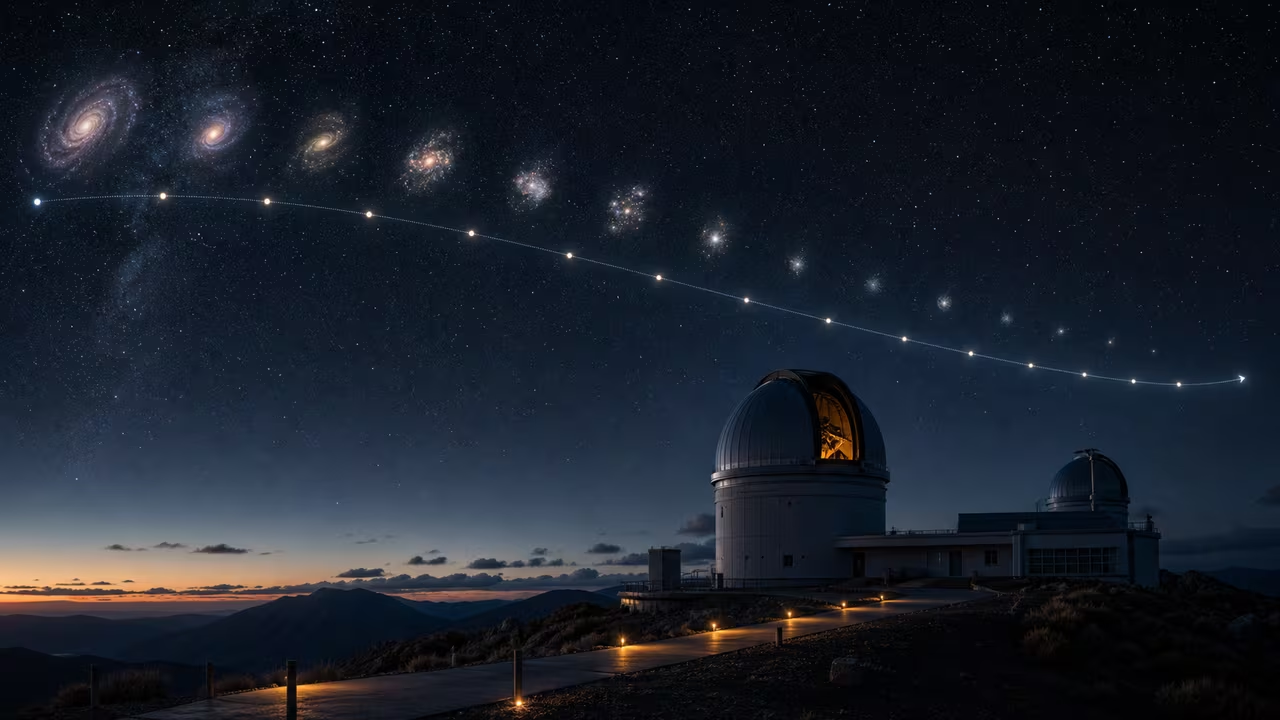
If dark energy persists unchanged, the universe approaches a state dominated by cold, empty space punctuated by isolated black holes. These black holes slowly evaporate through Hawking radiation over timescales ranging from 10⁶⁷ years (stellar mass) to 10¹⁰⁰ years (supermassive). After the last black hole evaporates, the universe becomes a diffuse sea of particles and photons, approaching absolute zero asymptotically but never quite reaching it.
Could intelligence persist into this far future? Freeman Dyson proposed that beings could survive indefinitely by thinking ever more slowly, using less energy as the universe cooled. But this proposal faces challenges: if protons decay (with half-lives perhaps around 10³⁴ years), atoms themselves are temporary. Quantum fluctuations might eventually produce Boltzmann brains, random observers assembled by chance, raising troubling questions about what counts as genuine existence.
The Omega Point hypothesis speculates that intelligent life could come to dominate the universe's dynamics, steering cosmological evolution to maximize computation. In the most ambitious version, the universe's final moments involve infinite information processing, effectively creating a computational afterlife. Current physics gives little reason to expect this outcome. Still, the idea illustrates how far extrapolation from known principles can venture before it leaves firm ground.
Information may be the universe's most enduring currency. Even after matter has decayed and structure has dissolved, correlations in radiation might preserve information about what once existed. Whether anything could extract this information, or whether preservation without extraction matters, remains philosophically unclear. The deep future is strange territory where physics, philosophy, and theology meet without agreeing on a common language.
Far-future thinking is humbling because it removes every familiar scale. Human projects last years or centuries. Stars last billions of years. Black holes can last far longer than stars. Once the timeline reaches those depths, ordinary intuition has to give way to conservation laws, decay rates, and entropy. That surrender is not bleak. It is one of the ways physics teaches proportion.
Omega Point Computation Capacity Calculator
Explore the theoretical maximum computational capacity as the universe approaches its limits.
Assumptions, Units, and Physical Constants
The calculators throughout this guidebook use standard SI units unless otherwise noted. Cosmological calculations assume a flat ΛCDM (Lambda Cold Dark Matter) universe with parameters consistent with current observations. Results should be interpreted as order-of-magnitude estimates illuminating physical relationships rather than engineering specifications.
Key physical constants used include the speed of light c ≈ 299,792,458 m/s, gravitational constant G ≈ 6.674×10⁻¹¹ m³·kg⁻¹·s⁻², Planck's constant h ≈ 6.626×10⁻³⁴ J·s (and ℏ = h/2π), Boltzmann constant k_B ≈ 1.381×10⁻²³ J/K, and solar luminosity L☉ ≈ 3.828×10²⁶ W. Where cosmology matters, we use Hubble parameter H₀ ≈ 70 km/s/Mpc and dark energy equation of state w ≈ -1 unless the calculator exposes these as adjustable parameters.
Many calculations involve extreme numbers: energies equivalent to stellar masses, timescales spanning billions of billions of years, and distances across observable universes. Scientific notation and orders of magnitude are essential tools. A result of 10⁵⁰ joules should be read as "roughly ten to the fiftieth power." The exact digits matter far less than the exponent. Developing comfort with such numbers is part of building intuition about cosmic scales.
Glossary of Cosmic Strangeness
- Decoherence
- The process by which quantum superpositions lose coherence through interaction with the environment, causing systems to behave classically.
- False Vacuum
- A metastable state that appears to be ground state locally but could tunnel quantum mechanically to a lower-energy true vacuum.
- Equation of State (w)
- The ratio of pressure to energy density for a cosmic component. w = -1 for cosmological constant; w < -1 leads to Big Rip.
- Event Horizon
- The boundary around a black hole beyond which nothing can escape; also the cosmic boundary beyond which light can never reach us due to expansion.
- Exotic Matter
- Hypothetical matter with negative energy density, required by many speculative spacetime geometries like traversable wormholes.
- Hawking Radiation
- Thermal radiation emitted by black holes due to quantum effects near the event horizon, causing slow evaporation over cosmic timescales.
- Planck Units
- Natural units derived from c, G, and ℏ that set the scale where quantum gravity effects become important (Planck length ≈ 10⁻³⁵ m).
A Note on Safety and Perspective
Some thought experiments discussed here, including quantum suicide and cosmic doom, touch on disturbing themes. They are presented purely for intellectual exploration and scientific understanding. The quantum suicide thought experiment illustrates interpretations of quantum mechanics; it is absolutely not a recommendation or anything close to one. Never risk your safety based on theoretical physics.
The vast timescales and improbabilities involved in cosmic doom scenarios should provide perspective, not anxiety. Vacuum decay might be possible, but current physics suggests we are stable on timescales far exceeding stellar lifetimes. The Big Rip might occur, but likely tens of billions of years from now, if it occurs at all. Gamma-ray bursts might sterilize planets, but the nearest candidates are far enough away to pose negligible risk. Understanding these scenarios quantitatively reveals that most represent no practical threat.
Finally, remember that even established physics operates at the frontier of human knowledge. Today's confident claims may be revised by tomorrow's discoveries. The history of physics is full of overturned certainties and unexpected revelations. Approach strange physics with intellectual humility, confident in the power of mathematical reasoning while remaining open to surprises yet to come.