
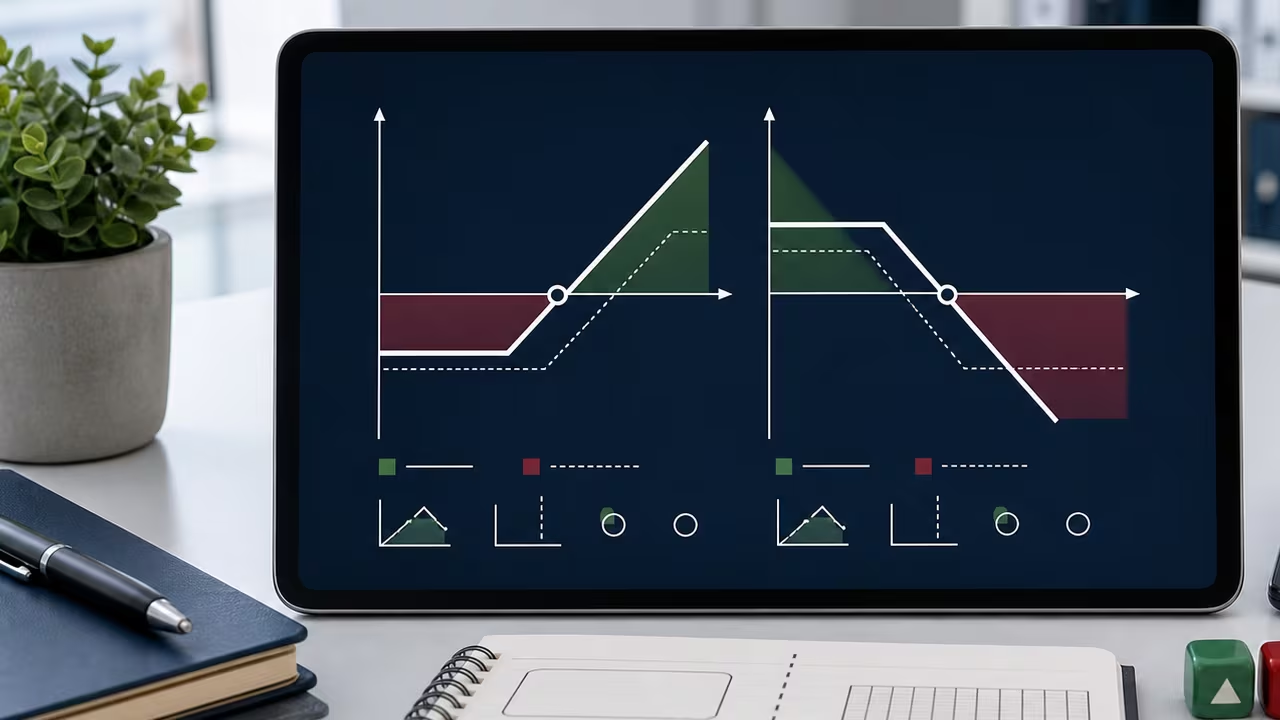
What a single call or put actually makes at expiration
An option is the right, but not the obligation, to buy or sell an underlying asset at a fixed strike price by a set expiration date. That one clause is enough to bend the payoff into a shape that owning the stock never produces: capped losses on one side, leverage on the other, and a break-even that sits away from the strike. This calculator answers the narrow, high-value version of the question every options trader eventually asks: with the premium already accounted for, what does one plain call or put earn or lose if the stock closes at a given price on expiration day? Whether you are pricing out a bullish call, a bearish put, or the income you collect for selling either one, the page converts strike, premium, and settlement price into a single dollar figure.
The tool works with four common positions: long call, short call, long put, and short put. It reports the net profit or loss per share, the option's intrinsic value at expiration, the break-even price, and whether the option finishes in or out of the money. That distinction matters because an option can be in the money and still lose money overall if the intrinsic value is smaller than the premium paid. Many beginners mix up exercise value with actual profit, so the calculator keeps both numbers visible.
Everything on this page is expressed on a per-share basis because that is the clearest way to learn the payoff math. In the real U.S. equity market, one standard option contract usually controls 100 shares. After you calculate the per-share result here, multiply by 100 for one contract, or by 100 times the number of contracts for a larger position. That simple scaling step helps connect classroom-style formulas to the way traders actually size positions.
Filling in the trade and reading the payoff
Start by choosing the option type. A call benefits from higher underlying prices if you are long the option, while a put benefits from lower underlying prices if you are long the option. Next choose the position. Long means you bought the option and paid the premium upfront. Short means you wrote or sold the option and collected the premium upfront. The calculator uses that long-versus-short choice to flip the payoff correctly without asking you to enter the formula manually.
Then enter the strike price, the premium, and the underlying price at expiration. The strike price is the agreed purchase price for a call or sale price for a put. The premium is what the buyer pays and the seller receives. The underlying price at expiration is the market price of the stock, ETF, index, or other asset at the moment the option settles. Use consistent units throughout. If the strike is in dollars per share, the premium and final price should also be in dollars per share.
When you press calculate, read the output in a sequence that mirrors how options are analyzed in practice. First, look at intrinsic value to see how much exercise value exists at expiration. Second, look at the profit or loss line to see the actual net result after premium. Third, check the break-even price to learn where the trade switches from gain to loss. Finally, note the status line. In the money describes the option's exercise value; it does not guarantee profitability by itself.
This calculator is especially useful for scenario analysis. Change only the expiration price and watch how the result moves. Then keep the expiration price fixed and compare different strikes or premiums. That side-by-side experimentation is one of the fastest ways to build intuition. For example, you may notice that a cheaper out-of-the-money call needs a larger stock move to reach profitability, while an expensive near-the-money call may need less movement but costs more upfront. The same logic applies to puts in reverse.
Leverage is another reason to test several inputs. Because an option premium is usually much smaller than the stock price, a favorable move can create a very large percentage return on the premium paid. The trade-off is that long options can also lose 100% of their premium if the move does not happen by expiration. This tool makes that asymmetry visible in plain dollars rather than vague intuition. It is often easier to make sound decisions once the possible outcomes are quantified.
The calculator is also helpful for hedging examples. If you own shares and buy a protective put, the put profit can offset part of the stock loss when the market falls. If you sell a covered call, the option premium can add income but caps some upside beyond the strike. This page calculates only one option leg at a time, but even that single-leg view can clarify how the option itself behaves before you combine it with stock or with other options in a larger strategy.
The expiration payoff math, position by position
At expiration, option pricing becomes much simpler than it is before expiration. Time value disappears and only intrinsic value remains. For a long position, net profit equals the value of the option at expiration minus the premium paid. For a short position, the direction reverses because the seller receives the premium first and later may owe intrinsic value to the buyer. The core relationship is preserved below in MathML.
Plain-text formulas: Long call per-share payoff: max(S - K, 0) - premium. Long put per-share payoff: max(K - S, 0) - premium. Short call per-share payoff: premium - max(S - K, 0). Short put per-share payoff: premium - max(K - S, 0). Total P/L: perSharePL * contractMultiplier * contracts - fees.
For a long call, the value at expiration is defined by , where is the stock price and is the strike. The break-even price is simply the strike plus the premium paid. For a short call, profit reverses, and the maximum gain equals the premium while risk can be unlimited.
For puts, intrinsic value flips direction because the holder gains when the market finishes below the strike. In plain language, a put has exercise value only when the underlying closes under the strike price. That value can be written as . Long puts subtract the premium from that value, while short puts keep the premium unless falling prices create enough intrinsic value to overwhelm it.
Those break-even formulas explain a common surprise. A long call can finish in the money and still lose money if the stock ends above the strike but not by enough to recover the premium. A long put has the same issue on the downside. Premium is what shifts the zero-profit line away from the strike. The calculator makes that shift explicit so you can see not just whether an option has value, but whether it has enough value.
| Position | Outcome if in the money | Outcome if out of the money |
|---|---|---|
| Long Call | Unlimited gain above strike minus premium | Loss limited to the premium paid |
| Short Call | Premium minus intrinsic value, with potentially very large losses | Keeps the premium received |
| Long Put | Gain increases as price falls below strike minus premium | Loss limited to the premium paid |
| Short Put | Premium minus intrinsic value, with major downside risk if price falls | Keeps the premium received |
Once you understand the table, the calculator output becomes easier to interpret. Intrinsic value tells you whether the option has exercise value. Profit or loss tells you whether that exercise value was enough after premium. Break-even tells you the exact expiration price where the sign changes. Together, those three ideas describe the full expiration payoff for a single option.
Working through a call, a put, and the short side
Suppose you buy a call with a strike price of $50 and pay a premium of $2. If the underlying asset finishes at $60 on expiration day, the call's intrinsic value is $10 because you can buy at $50 and immediately own something worth $60. Net profit is $10 minus the $2 premium, or $8 per share. For one standard contract on 100 shares, that would be about $800 before commissions and taxes. The break-even is $52, so anything above $52 produces a profit at expiration.
Now move the same example to a final price of $51. The option is still in the money because the stock is above the strike, but intrinsic value is only $1. After subtracting the $2 premium, the position still loses $1 per share. This is the classic case where in the money does not mean profitable. Many new traders expect any in-the-money finish to be a win, and this calculator helps correct that misunderstanding immediately.
Consider a put example as well. If you buy a put with a $40 strike for a $1 premium and the stock finishes at $30, the intrinsic value is $10 because the holder can effectively sell at $40 while the market is at $30. Net profit becomes $9 per share after subtracting the premium. The break-even price is $39, meaning the stock must fall below $39 at expiration for the long put to earn a profit. At $39 exactly, the position is at break-even.
Short positions show the mirror image. If you sell that same $40 put for a $1 premium and the stock expires at $30, you do not keep the entire premium. Instead, you owe $10 of intrinsic value to the long put holder and are left with a net loss of $9 per share after the premium offset. If the stock had instead finished at $42, the put would expire worthless and the short seller would keep the $1 premium. That contrast is why short option strategies can look steady for many small moves but become painful when the market moves far enough.
Worked examples like these are useful because they bridge the gap between a payoff diagram and a real trade idea. If you are evaluating an earnings trade, a hedge, or a premium-selling strategy, try three or four possible expiration prices rather than only one. A single scenario tells you what happens if you are exactly right. A small set of scenarios tells you how forgiving or unforgiving the trade is if reality lands somewhere else.
Where this expiration model stops and real trading begins
This calculator intentionally uses a simplified expiration-only model. It does not estimate what an option is worth before expiration, and it does not model implied volatility, time decay, early exercise incentives, bid-ask spreads, commissions, taxes, slippage, or margin interest. All of those can matter in real trading. Before expiration, an option can trade above intrinsic value because the market is also pricing time and uncertainty. That is why a position may show a profit or loss in your brokerage account before expiration that looks very different from the final payoff shown here.
The tool also assumes you are analyzing one option by itself. Multi-leg strategies such as straddles, strangles, vertical spreads, iron condors, collars, covered calls, and protective puts combine several positions at once. You can still use this calculator for those strategies by evaluating each leg separately and then adding the results, but the page does not automate that combination. Its purpose is to make the building blocks obvious before you move on to more advanced structures.
Risk limits are another important caveat. A long option can lose only the premium paid, which is straightforward. A short call can face theoretically unlimited risk because there is no ceiling on how high the underlying price can rise. A short put has substantial downside exposure because the underlying can fall toward zero. Broker margin rules, assignment procedures, and liquidity can affect real outcomes. This calculator cannot substitute for understanding those operational risks.
Greeks such as delta, gamma, theta, and vega are also outside the scope of this page. Those measures describe how an option price changes before expiration as the underlying price moves, time passes, or implied volatility changes. They are essential for active traders who adjust positions early, but they rely on more advanced pricing models. This calculator stays focused on terminal payoff because that is the clearest starting point and the final destination for any option held to maturity.
Even with those limitations, expiration payoff math is still the foundation of options education. It helps you judge whether a premium is worth paying, whether a short option leaves enough room for error, and how far the underlying must move before a strategy becomes attractive. If you use the numbers here as a first-pass planning tool rather than a complete trading model, the calculator can be extremely useful. It is best viewed as a learning aid and scenario checker, not as personalized financial advice.
Finally, remember that options are tools. Investors use them for speculation, income generation, hedging, and structured risk control. The same flexibility that makes them powerful also makes them easy to misuse. Running a few expiration scenarios before placing a trade can slow you down in a productive way. It forces a simple question: if the market finishes here, what exactly do I make or lose? That habit alone can improve discipline.
Option Profit FAQ
Does this option profit calculator predict market prices?
No. It estimates expiration payoff from your inputs. It does not forecast the underlying price, implied volatility, liquidity, assignment, taxes, or brokerage margin requirements.
Why can an in-the-money option still lose money?
An option is in the money when it has intrinsic value, but a long option also has to recover the premium paid. Profit begins only beyond the break-even price.
Does the calculator include fees and contract size?
Yes. The calculator accepts number of contracts, contract multiplier, and commissions or fees, then reports both per-share and total contract-level profit or loss.
Is this financial advice?
No. This is an educational scenario tool. Options involve risk and are not suitable for every investor. Before trading, review the OCC options disclosure document, exchange education such as Cboe Options Institute, and advice from a qualified financial professional.
Choose an option type and enter trade details to estimate profit at expiration on a per-share basis.
Clipboard feedback will appear here after you copy a result.
Mini-Game: Break-Even Rush
This optional practice game turns option math into a quick timing challenge. Each falling contract shows a type, a position, a strike, and a premium. Your job is to move the glowing expiration-price beam onto the profitable side of the break-even line before the contract reaches settlement. It does not change the calculator's math above, but it gives you a playful way to internalize how premium shifts break-even and how long and short positions reverse the favorable side of the price range.
Optional practice only: use the calculator above for the exact per-share answer on your own trade inputs.