Gravitational Time Dilation Calculator

Introduction: How Gravity Changes Clock Rates
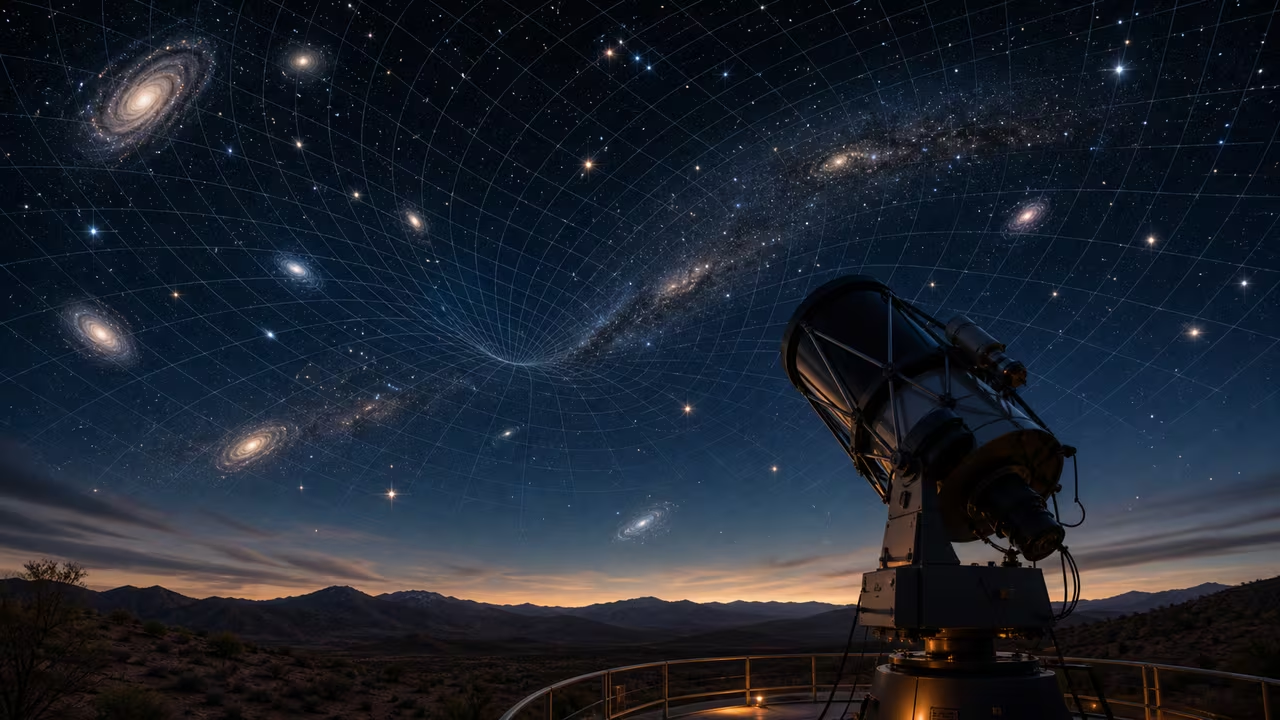
Gravitational time dilation is the difference in clock rate caused by gravitational position. In general relativity, mass curves spacetime, so a clock deeper in a gravitational field accumulates less proper time than a clock far from the mass. A clock at Earth’s surface therefore runs slightly more slowly than one farther from Earth’s center, while the contrast near a compact object can be much larger. This calculator focuses on that gravitational clock-rate comparison for a specified mass and radial distance.
The Schwarzschild Gravitational Time-Dilation Formula
For the nonrotating, spherically symmetric mass assumed by this gravitational time-dilation calculator, a clock at radial distance from the center is compared with a clock far from the mass by
Formula: Δt_∞ = (Δ τ) / (sqrt(1 − (2 G M) / (c^2 r)))
In this Schwarzschild relation, is the interval measured by the distant observer and is the proper interval measured locally. The symbols , , , and denote the gravitational constant, the central mass, the speed of light, and the center-to-clock distance. The calculator reports the directly useful clock-rate ratio:
Formula: (Δ τ) / Δt_∞ = sqrt(1 − (2 G M) / (c^2 r))
For a fixed mass, decreasing lowers this ratio. The local clock then advances by a smaller fraction of the time recorded far away. For a fixed distance, increasing the entered mass has the same direction of effect.
Earth-Based Gravitational Clock Differences
Gravitational time dilation around Earth is small, but precision clocks can measure it. A clock on a mountain is farther from Earth’s center than one at sea level and consequently runs slightly faster in this gravitational comparison. Satellite timing systems also require relativistic modeling because small rate differences accumulate into meaningful timing and position errors. The effect is not an abstract property of distant black holes; it is a measurable feature of clocks in Earth’s gravity.
Gravitational Time Dilation in Extreme Gravity
Near a sufficiently massive and compact object, the factor calculated here can depart substantially from one. As the radial distance approaches the Schwarzschild radius, the square-root expression approaches zero for the idealized external Schwarzschild geometry. In the distant coordinate description, the local clock rate correspondingly tends toward zero. This calculator is most useful for illustrating how strongly mass and compactness together control that change in clock rate.
Astronomical Tests of Gravitational Clock Rates
Measurements of gravitational time dilation compare frequencies or elapsed times at different gravitational potentials. The Pound–Rebka experiment measured a gravitational frequency shift over a height difference, and modern atomic clocks can resolve much smaller altitude-related differences. In astronomy, timing observations of pulsars and binary systems can also reveal relativistic effects. Such measurements test the same general principle represented by this calculator: gravity changes the relation between local proper time and a distant reference time.
GPS and Gravitational Time Dilation
GPS provides a practical example of gravitational time dilation in engineering. Satellite clocks are higher in Earth’s gravitational field than clocks on the ground, so their gravitational contribution differs from the surface-clock rate. Their orbital motion also creates a separate special-relativistic contribution in the opposite direction. Operational GPS timing accounts for both effects; this calculator isolates only the gravitational Schwarzschild factor and does not include orbital velocity.
What Gravitational Time Dilation Means Geometrically
Gravitational time dilation expresses the geometric role of gravity in general relativity. Rather than treating time as an identical background tick everywhere, the theory assigns different proper-time intervals to different spacetime paths. The mass and radius entered above specify an idealized geometry in which the central body is spherical and static. The resulting factor is therefore a compact way to describe how location in that geometry affects a clock.
How to Use the Gravitational Time Dilation Calculator
To calculate a Schwarzschild clock-rate factor, enter the central mass in solar masses and the clock’s distance from the center in kilometers. After you select Compute Dilation Factor, the script converts the mass and distance to SI units and evaluates the square-root ratio shown above. A displayed value of 0.9 means that the local clock accumulates 0.9 seconds of proper time for every second measured far from the mass. Check especially that the distance is measured from the center, not from the object’s surface.
Limitations and Extensions of the Schwarzschild Time-Dilation Model
This gravitational time-dilation calculator assumes a static, spherical, uncharged mass. It does not model spin, electric charge, a non-spherical mass distribution, a changing gravitational field, or the clock’s velocity. Rotating compact objects can introduce frame-dragging effects and require a rotating-spacetime treatment such as the Kerr metric. The Schwarzschild expression remains a useful idealized external solution, but it should not be read as a complete model of every astronomical environment.
Gravitational Time Dilation Beyond Black Holes
Gravitational time dilation occurs around every mass, not only black holes. White dwarfs, neutron stars, planets, and spacecraft trajectories all involve gravitational potential differences that can affect precision timing. The size of the effect depends on mass relative to radial distance, which is why compact objects produce much stronger changes than diffuse bodies of comparable scale. When interpreting a result, consider both entered quantities together rather than treating mass alone as the indicator of strong dilation.
Human Perspective on Gravitational Clock Slowing
Gravitational time dilation has a direct interpretation for elapsed aging: a clock following the local path records its own proper time. Someone remaining closer to a compact massive object would accumulate less proper time than a distant observer, provided the comparison can be defined within the physical situation. Near Earth, that difference is far too small to notice without specialized clocks. The contrast between those everyday scales and strong-gravity environments makes the calculator’s ratio easier to place in perspective.
Historical Evidence for Gravitational Time Dilation
Gravitational time dilation was anticipated in Einstein’s early work and became part of the full general-relativistic account of gravity. Experiments using frequency shifts and transported atomic clocks have tested gravitational and kinematic timing effects under controlled conditions. These observations support the central point used by this calculator: measured elapsed time depends on a clock’s path and gravitational setting, rather than being a universal rate shared by all observers.
Final Thoughts on Gravitational Time Dilation
This gravitational time-dilation calculator gives a focused numerical view of the Schwarzschild clock-rate effect. Try changing the mass or the center-to-clock distance one at a time to see which quantity drives the ratio toward one or toward stronger slowing. For realistic interpretation, use physically meaningful distances outside the object and remember that the result compares a stationary local clock with a reference clock far away. That defined comparison is the key to understanding what the displayed factor represents.
Arcade Mini-Game: Gravitational Time Dilation Calculator Calibration Run
Use this quick arcade run to practice separating useful scenario inputs from common planning mistakes before you rely on the calculator output.
Start the game, then use your pointer or arrow keys to catch useful inputs and avoid bad assumptions.