Door Rough Opening Calculator

Introduction: what a door rough opening includes
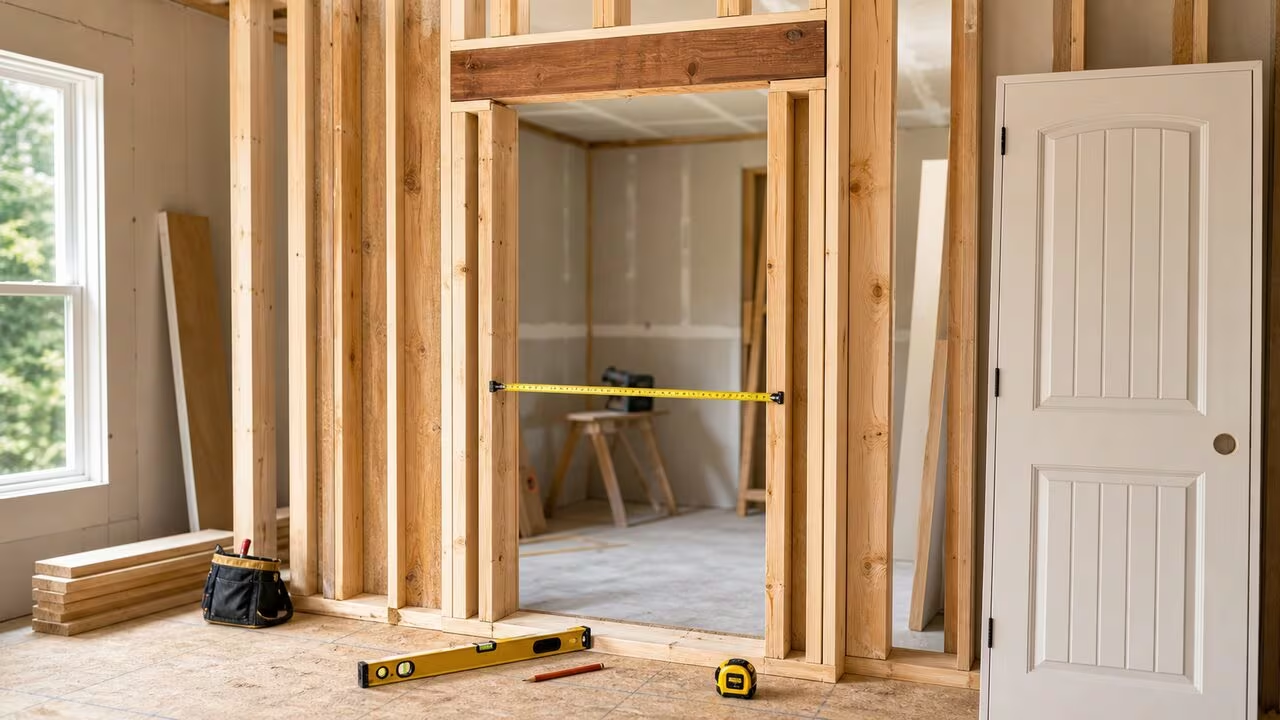
A door rough opening is the framed hole a carpenter prepares in a wall before the prehung door, jamb, shims, and casing go in. It is deliberately larger than the door slab itself, because the installer needs room to stand the jamb plumb and square inside imperfect framing, slide tapered shims behind the hinge and latch sides, and leave clearance under the slab for flooring, a threshold, or an undercut for return air. Frame the hole exactly the size of the door and the unit physically will not fit; frame it far too large and the shims cannot bridge the gap.
For most residential prehung interior doors, a practical planning allowance is about 2 inches wider and 2 to 2.5 inches taller than the nominal slab size. Exterior doors, fire-rated doors, pocket doors, thick custom jambs, and specialty thresholds all shift those numbers, which is why this calculator lets you set the total extra width and height yourself and treats the manufacturer's installation sheet as the final authority.
Rough opening is a framing dimension, not a finished one. It is the clear distance measured between the inside faces of the two jack studs, and from the floor reference you will actually build to up to the underside of the header. Everything you can see once the room is finished, including drywall, casing, and the door stop, sits inside that hole rather than defining it. That distinction matters because a wall can look right and still be framed wrong: 1/2-inch drywall wrapped into an opening steals a full inch of width that the jamb was counting on.
The rough opening formula and its allowances
The math is intentionally transparent. For a prehung unit the rough opening is the slab dimension plus a total allowance in each direction:
The allowances are total opening allowances, not per-side values. Entering 2 inches of extra width leaves about 1 inch of clearance on each side of the jamb before shimming:
A pocket door does not follow that pattern at all, because the slab has to slide completely inside the wall. Frame kits are dimensioned from the slab width instead:
Once the opening is fixed, the header that caps it has to reach past the jack studs to bear on the king studs, so its length depends on how many jacks each side carries:
Plain-text formula: roughWidthIn = doorWidthIn + totalExtraWidthIn; roughHeightIn = doorHeightIn + totalExtraHeightIn + finishedFloorBuildupIn; sideClearanceIn = totalExtraWidthIn ÷ 2; pocketRoughWidthIn = 2 × doorWidthIn + 1; headerLengthIn = roughWidthIn + 2 × jacksPerSide × 1.5 in. Default planning allowance is door width + 2 in and door height + 2 to 2.5 in; the door manufacturer instructions control the final dimensions.
Framing anatomy: king studs, jack studs, and the header
The rough opening lives inside a small structural system. Full-height king studs run plate to plate on each side. Shorter jack studs (also called trimmers) are nailed to the kings and carry the header, the horizontal member that bridges the opening and picks up any load from above. Short cripple studs fill the space between the header and the top plate so the drywall has backing. The rough opening width is the clear distance between the jack studs; the rough opening height runs from the floor reference to the underside of the header.
Because dimensional lumber is 1.5 inches thick, the header must be longer than the opening it spans: with a single jack stud on each side the header length is the rough opening width plus 3 inches, and with doubled jacks (common for wide or heavily loaded openings) it is the rough opening width plus 6 inches. Measured across the outside faces of the king studs, the whole assembly occupies the header length plus another 3 inches, which is the number to use when you are laying out plates and checking that the opening still clears the next stud bay. The calculator prints these framing helpers with every result so you can rough out a cut list from the same numbers.
Where the 2-inch rule comes from
The common interior allowance is not folklore; it falls straight out of the jamb stock. A typical prehung interior jamb is 3/4-inch material, so the two jamb legs add 1.5 inches to the slab width. Add 2 inches total and you are left with roughly 1/4 inch of shim space per side, which is enough to plumb the jamb inside slightly bowed studs without exceeding what shims and casing can hide. Height works the same way: a 3/4-inch head jamb, roughly 3/4 inch of clearance under the slab for flooring, and a little shim space at the top add up to the familiar 2 to 2.5 inches over an 80-inch slab, which is why an 80-inch door usually gets an opening of 82 to 82.5 inches.
Manufacturers tend to state the same idea one step further along the chain. Therma-Tru's prehung installation instructions, for example, ask for a rough opening about 1/2 inch taller than the assembled frame and 1/2 to 3/4 inch wider, and because that frame already wraps the slab in jamb stock, the arithmetic lands back on roughly slab plus 2 inches. Working from the unit dimension is more precise when you have the unit in front of you; working from the slab size is more useful when you are framing before the door has been ordered.
Interior, exterior, and double doors
Exterior prehung units usually need a little more height than interior ones because the slab sits on a raised threshold over a sill pan, and the pan flashing and sloped sill eat vertical space. Plan on the same 2 inches of width and 2.5 inches of height as a starting point, then add another 1/2 inch of height if the unit ships with an adjustable sill or a separate sill pan. Double doors (a pair of slabs meeting with an astragal) follow the same width formula, just applied to the combined slab width: a pair of 30-inch slabs is 60 inches of door, so about a 62-inch rough opening.
Width matters for more than fit. The IRC requires at least one side-hinged egress door per dwelling unit that gives a clear width of not less than 32 inches with the door open 90 degrees and a clear height of not less than 78 inches, measured to the face of the door and the stop rather than to the framing. A 32-inch slab does not deliver 32 inches of clear width once the jamb, stop, and open door leaf are subtracted, so a 36-inch door is the usual way to satisfy that requirement comfortably.
Pocket, bifold, and bypass openings
Specialty doors break the slab-plus-allowance model in different directions, and mixing them up is the single most expensive framing mistake on this page.
Pocket doors need roughly double the slab width plus about an inch, because the split-stud frame has to swallow the entire slab. Johnson Hardware's 1500 series frames, one of the most widely stocked kits in North America, list a 61-inch by 84.5-inch rough opening for a 30-inch door and a 65-inch by 84.5-inch opening in a 2x4 wall for a 32-inch door. That is 2 x 30 + 1 and 2 x 32 + 1 respectively, with 4.5 inches added to the 80-inch slab height for the track.
Bifold doors are sized to the finished opening rather than to a rough opening. Reeb's supplier documentation is explicit: bifold finished opening widths are true to the call size, so a 3/0 bifold wants a 36-inch finished opening and a 6/0 unit wants 72 inches, with the slabs themselves running about 1/4 inch undersized so the hardware has room. The standard finished opening height is 81 inches. To get from there to a rough opening you add the jamb stock back on, which is why a 3/0 bifold is normally framed at about 38 inches wide and 82 inches tall.
Bypass (sliding closet) doors behave like bifolds: the track is cut to the finished opening, and the panels overlap. Barn-door hardware is different again, because the door hangs on the face of the wall and the opening only has to be smaller than the slab, not larger. Use the slab-only or custom mode for all of these and let the hardware instructions govern.
Header size and jack studs under the IRC
This calculator sizes the length of the header, never its depth. Depth is a structural question, and the International Residential Code splits it cleanly in two.
In an interior or exterior nonbearing wall, section R602.7.4 permits a single flat 2-inch by 4-inch member to serve as the header for openings up to 8 feet wide, provided the vertical distance to the parallel nailing surface above is not more than 24 inches; no cripples or blocking are required above such a header. That covers the overwhelming majority of interior partition doors, which is why so many remodels get away with a flat 2x4 on edge-nailed jacks.
In a load-bearing wall, the header must be sized from IRC Table R602.7(1) for exterior bearing walls or Table R602.7(2) for interior bearing walls, using your building width, ground snow load, and the number of floors and roofs the wall supports. For a 28-foot-wide building with a 30 psf ground snow load carrying one floor plus the roof, the published spans land near a doubled 2x6 for a 4-foot opening, a doubled 2x10 for a 6-foot opening, and a doubled 2x12 for an 8-foot opening; beyond that the header needs engineering. Headers must bear on at least 1.5 inches of jack stud at each end, and Table R602.7.5 sets how many full-height studs each end needs as the span and wind exposure grow.
Worked example: framing a 32 by 80 bedroom door
Suppose you are hanging a 32 inch by 80 inch interior prehung door with 2 inches of width allowance and 2.5 inches of height allowance, in a nonbearing partition, on a subfloor that will later receive 3/4 inch of engineered hardwood.
Width: 32 + 2 = 34 inches
Height from the finished floor: 80 + 2.5 = 82.5 inches
Height from the bare subfloor: 80 + 2.5 + 0.75 = 83.25 inches
Header length, one jack per side: 34 + 3 = 37 inches
King stud outside-to-outside: 37 + 3 = 40 inches
That gives a planning rough opening of 34 in wide by 83.25 in tall from the subfloor, with about 1 inch of clearance per side before shimming and a header cut at 37 inches. Because the wall is nonbearing and the opening is well under 8 feet, a single flat 2x4 header is code-compliant here. Before cutting or framing, compare those numbers against the sheet packed with the actual door.
Common planning sizes
| Door slab | Planning rough opening | Approximate metric | Common use |
|---|---|---|---|
| 24 in x 80 in | 26 in x 82.5 in | 660 x 2096 mm | Small closet or powder room |
| 28 in x 80 in | 30 in x 82.5 in | 762 x 2096 mm | Closet or small interior room |
| 30 in x 80 in | 32 in x 82.5 in | 813 x 2096 mm | Interior passage door |
| 32 in x 80 in | 34 in x 82.5 in | 864 x 2096 mm | Bedroom or wider passage door |
| 36 in x 80 in | 38 in x 82.5 in | 965 x 2096 mm | Entry, accessibility, or utility space |
| 36 in x 96 in | 38 in x 98.5 in | 965 x 2502 mm | Tall entry door |
| 60 in x 80 in (pair of 30s) | 62 in x 82.5 in | 1575 x 2096 mm | Double doors to a den or patio |
| 72 in x 80 in (pair of 36s) | 74 in x 82.5 in | 1880 x 2096 mm | Wide double-door opening |
Specialty openings compared with a plain prehung door
| Door type | Width rule | Height rule | Rough opening | Controlling source |
|---|---|---|---|---|
| Interior prehung | Slab + 2 in | Slab + 2 to 2.5 in | 34 x 82.5 in | Door installation sheet |
| Exterior prehung | Slab + 2 in | Slab + 2.5 to 3 in | 34 x 83 in | Sill pan and threshold detail |
| Double prehung pair | Combined slabs + 2 in | Slab + 2.5 in | 66 x 82.5 in (pair of 32s) | Astragal and jamb kit |
| Pocket door | 2 x slab + 1 in | Slab + 4.5 in | 65 x 84.5 in | Pocket frame kit |
| Bifold unit | Finished opening + jambs | Finished opening + head jamb | 34 x 82 in | Bifold track hardware |
| Barn door | Opening narrower than slab | Track height governs | Not a slab-plus-allowance case | Barn-door hardware sheet |
How to use this rough opening calculator
- Select the planning mode that matches the door package: interior prehung, exterior prehung, double pair, pocket, bifold, slab-only note, or custom manufacturer allowance. Each mode preloads a sensible starting allowance, and pocket mode switches to the doubled-width frame rule automatically.
- Choose a common slab size, including double-door pairs, or enter the actual door width and height in inches. A 30-by-80 door usually means a 30 inch wide, 80 inch tall slab.
- Enter the total extra width and total extra height from the door instructions or your own planning allowance. These are total opening allowances, not per-side values.
- If the finished floor is not down yet, enter its build-up thickness so the height is measured correctly from the bare subfloor. Leave it at zero when you are measuring from the surface the jamb will actually sit on.
- Tell the calculator whether the wall is bearing or nonbearing and how many jack studs each side will carry, so the header length and the code note match what you are about to build.
- Read the result in decimal inches, carpenter fractions, feet and inches, and millimeters, then compare everything with the manufacturer instructions before framing, cutting, or ordering material.
If the door project is part of a larger remodel, the drywall sheet calculator can net the opening out of the wall area, and the baseboard and trim calculator covers the casing and base runs that finish the room.
Assumptions and limitations of these opening figures
- Planning aid, not a framing specification. It does not size headers structurally, evaluate load-bearing walls, or decide fire-rating clearances. Header depth on a bearing wall is governed by IRC span tables and by the authority having jurisdiction.
- Standard lumber assumed. The header-length helper assumes 1.5-inch-thick dimensional studs; engineered lumber, steel framing, and 2x6 walls change the arithmetic and the pocket-frame sizes.
- Flooring is your input. The build-up field only knows what you type. It cannot see whether tile, underlayment, or carpet is coming, and it does not add an undercut for return air.
- Specialty doors are approximations. Pocket, bifold, bypass, and barn-door hardware have their own opening rules that override the slab-plus-allowance model, and kits differ between manufacturers and between 2x4 and 2x6 walls.
- Egress and accessibility are separate checks. Clear width is measured to the face of the open door and the stop, not to the framing, so meeting a rough opening number does not by itself satisfy IRC R311.2 or an accessibility standard.
- Manufacturer sheet wins. Confirm final dimensions with the product instructions, local code requirements, and a qualified carpenter or inspector whenever the wall is structural.
Sources checked for these rules
Sources. The header, jack stud, and egress rules on this page were checked against the model code text and against published manufacturer installation data rather than trade rules of thumb:
- ICC Digital Codes, 2021 International Residential Code, section R602.7 Headers - header span tables R602.7(1) and R602.7(2), and jack stud counts in Table R602.7.5.
- UpCodes, IRC nonbearing wall headers (R602.7.3 / R602.7.4) - the single flat 2x4 header allowance for openings up to 8 feet.
- UpCodes, IRC R311.2 Egress door - 32 inch minimum clear width and 78 inch minimum clear height for the required egress door.
- Johnson Hardware, 1500 Series pocket door frame kits - published rough opening sizes behind the 2 x slab width + 1 inch rule.
- Reeb Learning Center, bifold finished openings - bifold call sizes are finished opening widths, with a standard 81 inch finished opening height.
- Therma-Tru, prehung entry and patio door installation instructions (PDF) - rough opening sized from the assembled frame plus shim clearance, with sill pan guidance.
- Masonite, how to measure for interior doors - jamb widths of 4-9/16, 5-1/4, and 6-9/16 inches for common wall thicknesses.
Door rough opening: frequently asked questions
How much bigger should a rough opening be than the door?
A common starting point for a prehung interior door is about 2 inches wider and 2 to 2.5 inches taller than the nominal door slab. The exact allowance depends on the jamb, shimming space, flooring, threshold, and manufacturer instructions.
Is rough opening measured from framing or drywall?
Rough opening is measured between unfinished framing members: king or jack studs side to side, and subfloor or finished floor reference to the underside of the header. Trim and drywall are not part of the rough opening measurement.
What is the rough opening for a 36 inch exterior door?
A common plan for a 36 by 80 exterior prehung door is a rough opening of about 38 inches wide by 82.5 to 83 inches tall, because the sill pan and threshold usually need more height than an interior head jamb. Exterior units vary more than interior ones, so treat the installation sheet packed with the door as the final answer.
What rough opening does a pocket door need?
A pocket door frame needs roughly twice the slab width plus 1 inch, and about 4.5 inches of extra height, because the whole slab has to disappear into the wall. Johnson Hardware lists a 61 inch wide rough opening for a 30 inch pocket door and a 65 inch wide opening for a 32 inch door, both 84.5 inches tall in a 2x4 wall.
How big does the header over a door need to be?
IRC section R602.7.4 permits a single flat 2 by 4 as the header in an interior or exterior nonbearing wall for openings up to 8 feet wide, provided the vertical distance to the parallel nailing surface above is not more than 24 inches. In a load-bearing wall the header depth has to come from IRC Table R602.7(1) or R602.7(2) for your building width, snow load, and supported floors, and it must bear on the jack studs listed in Table R602.7.5. This calculator reports header length, never header depth.
What if my rough opening is too big or too small?
An opening up to about an inch too wide can usually be saved with wider shims or by padding one side with a ripped strip of plywood or lumber nailed to the jack stud. An opening that is too small is the harder problem: jambs cannot be shimmed into space that does not exist, so a stud usually has to be moved or the header reset. That is why framers err slightly large, never small.
Do I measure rough opening height from the subfloor or the finished floor?
Measure from the surface the jamb legs will actually sit on. If flooring is not installed yet, measure from the subfloor and add the finished-floor thickness to your height allowance so the door clears carpet, tile, or hardwood that arrives later. If the finished floor is already down, measure from it directly.
Can this replace the door manufacturer's instructions?
No. Use this calculator for planning and sanity checks, then confirm the final opening with the specific prehung door, jamb kit, threshold, fire rating, and local framing requirements.
Framing Fit: build the rough opening
An elevation view of a stud wall. Each round names a door and asks you to slide the two jack studs and drop the header until the framed hole matches the rough opening that door needs. The tape-measure overlay reads the opening live, and the fit gauge underneath shows how far off you are: frame it too tight and the jamb will not go in, frame it too sloppy and the shims cannot bridge the gap. Both cost points, and too tight costs more.
Press Start round, then click or tap the canvas and use the arrow keys. The wall is drawn at 1/8 inch resolution.